The quantum key to seeing through chaos
New publication by Sylvain Gigan (LKB), Baptiste Courme (LKB), Hugo Defienne (INSP), Daniele Faccio (University of Glasgow), Chloé Vernière (INSP), Malo Joly and Raphael Guitter (co-authors)

Researchers from the Institut des NanoSciences de Paris (INSP, CNRS / Sorbonne Université), the Kastler Brossel Laboratory (LKB, CNRS / ENS-PSL / Sorbonne Université / Collège de France), and the University of Glasgow have developed an innovative method that renders a scattering medium transparent solely for information carried by entangled photon pairs, while the same medium remains completely opaque to a classical light.
Faithfully transmitting spatial information, such as the image of an object, is a major challenge in modern optics. However, this task becomes complex as soon as light travels through disordered media, such as biological tissues, atmospheric turbulence, or multimode optical fibres. In these environments, scattering scrambles the information, making the final image completely unreadable. To circumvent this phenomenon, wavefront shaping techniques have emerged as powerful tools. By modulating the phase of light using spatial light modulators (SLMs), they can compensate for scattering effects and refocus the light, whether it is classical or quantum. Until now, however, these methods simply inverted the scattering process without leveraging the quantum nature of light. Yet, quantum optics provides a fundamentally richer framework than its classical counterpart, relying on a “double linearity” that offers previously inaccessible transmission solutions. Exploiting this property, the research team proposes a method based on the spatial correlations of entangled photon pairs to overcome optical disorder and transform the complex medium into a selective filter capable of discriminating between classical and quantum information. Entanglement thus acts as a unique physical key to navigate through the chaos.
The experiment involves optimizing a phase mask on the SLM to specifically preserve the spatial correlations of entangled photons after they propagate through the scattering medium. This approach leads to physical solutions that are impossible to obtain using classical optimization methods. It relies on a unique property of entanglement: the preservation of correlations across different optical bases (here, the input imaging basis and the scattering medium’s specific basis). Thus, the spatial correlations of the photon pairs (the transmitted image) are preserved at the output, whereas classical light, subjected to the same basis change, sees its information systematically destroyed.
By transforming optical disorder into a selective filter capable of discriminating between classical and quantum information, this study marks a conceptual turning point: complex media are no longer merely obstacles to overcome but become active and programmable components. In the field of secure communications, this physical discrimination opens up highly promising prospects. In the longer term, this strategy could inspire new imaging techniques through biological tissues, bypassing the complex calculations required to invert the scattering process. Finally, the optimization process itself could help solve certain classes of so-called “hard” optimization problems, as it is akin to minimizing the energy of a complex physical system described by a Hamiltonian with multi-spin interactions.
This work is published in the journals Optica (optimization) and Nature Physics (selective image transmission).
References:
Non-classical optimization of entangled photons through complex media. Baptiste Courme, Chloé Vernière, Malo Joly, Daniele Faccio, Sylvain Gigan et Hugo Defienne, Optica (2026).
Entanglement-enabled image transmission through complex media. Chloé Vernière, Raphaël Guitter, Baptiste Courme et Hugo Defienne, Nature Physics (2026).
Teams and institutes :
Sorbonne Université, CNRS, Institut des Nanosciences de Paris
Laboratoire Kastler Brossel, ENS-Universite PSL, CNRS, Sorbonne Universite, College de France
School of Physics and Astronomy, University of Glasgow
For more information:
- Arxiv: Non-classical optimization of entangled photons through complex media,
Entanglement-enabled image transmission through complex media - https://www.lemonde.fr/sciences/article/2026/05/29/une-lumiere-quantique-qui-reste-nette-apres-avoir-traverse-le-brouillard_6694731_1650684.html
- https://www.radiofrance.fr/franceculture/podcasts/avec-sciences/avec-sciences-chronique-du-vendredi-29-mai-2026-2546806

Read also
Antimatter: coming soon to a lab near you?
News by Nancy Paul (co-author)
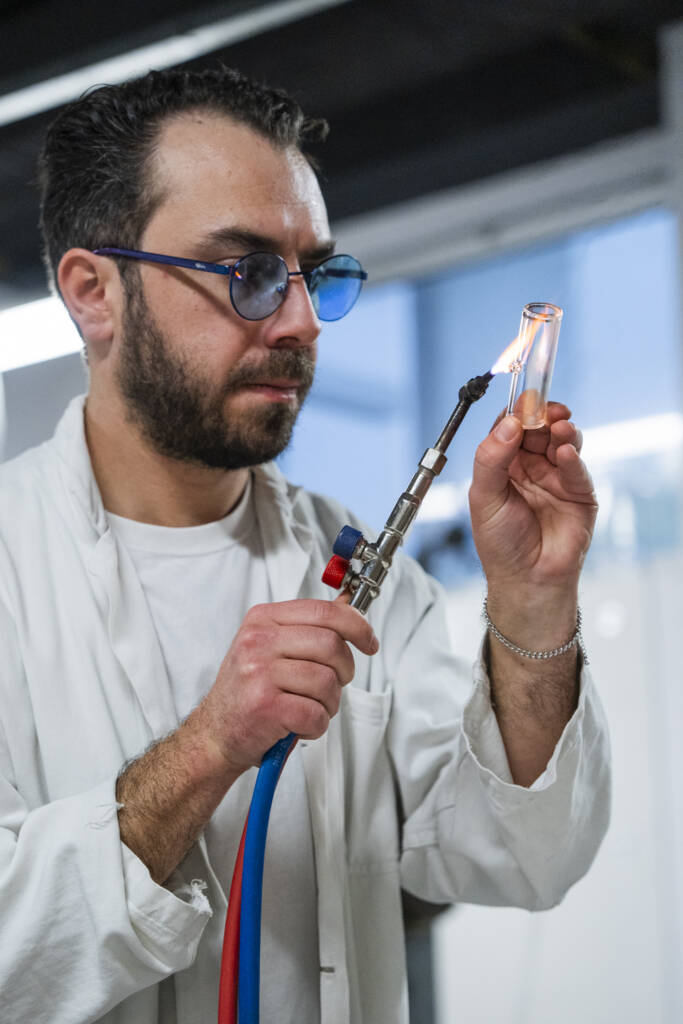
Glassblower at LKB – Tom Chevry
Interview published by Sciences Sorbonne Université
Shaking Atoms to Bring Black-Hole Quantum Chaos into the Lab
New publication led by Nathan GoldmanThis paper was selected as an Editors’ Suggestion in Physical Review Letters (PRL).