Sad news: death of Claude Cohen-Tannoudji
It is with great sadness that we learned of the death of Claude Cohen-Tannoudji, on 22 October.
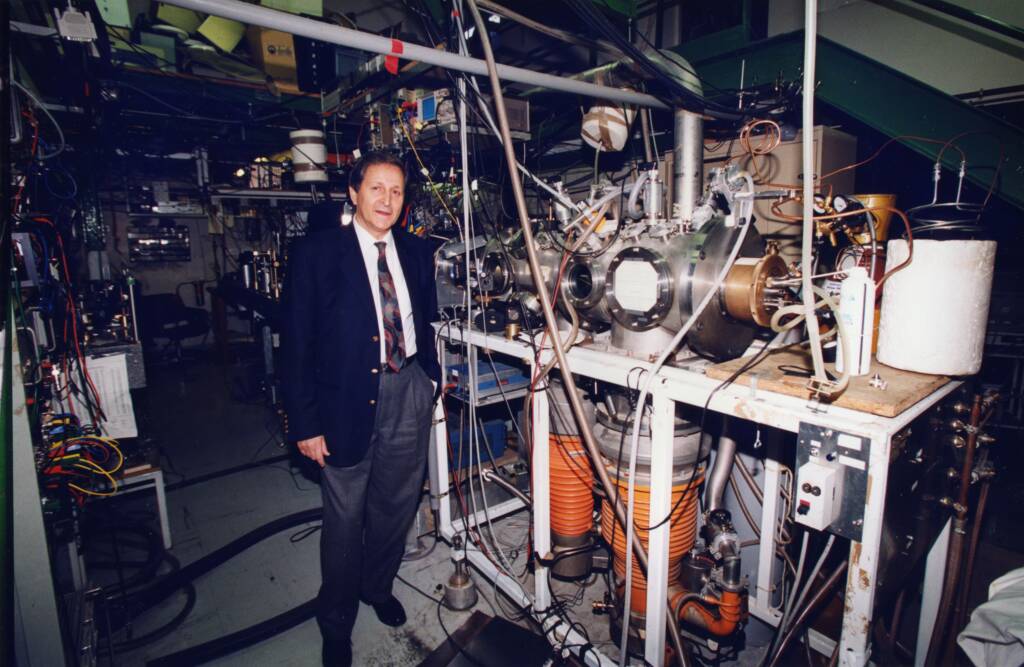
Claude Cohen-Tannoudji was born in Constantine in 1933. After completing his preparatory classes in Algiers, he was admitted to the École normale supérieure (ENS) in 1953. Initially drawn to mathematics, he was captivated by Alfred Kastler’s lectures. He therefore turned to physics and, in 1955, joined the group that Kastler had founded with his student Jean Brossel at the ENS Laboratory of Hertzian Spectroscopy. This laboratory later became the Kastler Brossel Laboratory in the ENS Department of Physics, where Claude would remain throughout his career.
After conducting his first research on the spectroscopy of atomic vapours, Claude completed his doctoral thesis, which he defended in 1962 under the title Quantum Theory of the Optical Pumping Cycle: Experimental Verification of Newly Predicted Effects. This title is emblematic of a career that consistently combined theory and experiment. His doctoral research highlighted a phenomenon that was difficult to observe and would later play a crucial role with the advent of lasers: light can shift the energy levels of an atom.
Further exploration of this research led him, together with his students, particularly Serge Haroche, to develop the concept of the “dressed atom”: the atom and the surrounding photon field form an inseparable whole, whose properties are revealed by its energy-level diagram. The full potential of this concept would emerge later in Claude’s career, when he turned his attention to the possibility of cooling and trapping atoms using light.
In 1984, Claude established a group combining experimental and theoretical research on the physics of cold atoms, together with Alain Aspect, Jean Dalibard and Christophe Salomon. They were joined a few years later by Yvan Castin, followed by Michèle Leduc. This group would achieve several world firsts, including the Sisyphus effect, which combines optical pumping and light shifts; cooling below the single-photon recoil limit; periodic lattices created by standing light waves; and the optics and interference of matter waves.
Claude’s research career was inseparable from his passion for sharing knowledge. At the age of 34, he became a professor at the Faculty of Sciences in Paris. Together with his colleagues Bernard Diu and Franck Laloë, he developed a renewed approach to teaching quantum physics, which gave rise to the book known as the Cohen, a landmark textbook that continues to educate generations of students.
Six years later, in 1973, he was appointed to the Collège de France, where he taught for 31 years. Many still remember his impeccably organised blackboards and handwritten notes. His lectures helped shape the entire French community working in quantum optics and atomic physics. Further books followed, covering quantum electrodynamics and light-matter interaction, written with Jacques Dupont-Roc, Gilbert Grynberg and David Guéry-Odelin. Beyond formal teaching, Claude was always willing to discuss ideas and share his knowledge with those who approached him. His generosity in inspiring and disseminating new ideas was unwavering.
Throughout his career, Claude Cohen-Tannoudji received numerous distinctions, too many to list exhaustively here. These included his election to the French Academy of Sciences in 1981, where he played an active role in defending persecuted scientists; the CNRS Gold Medal in 1996; and, of course, the crowning achievement of his career, the Nobel Prize in Physics in 1997, jointly awarded to him, Steven Chu and William D. Phillips. On that occasion, Claude concluded his speech with a quotation from Edmond Rostand: “It is at night that it is beautiful to believe in the light”—a phrase that perfectly captures his humanism.
To learn more about Claude Cohen-Tannoudji:
https://www.lkb.fr/laboratoire/presentation/histoire/claude-cohen-tannoudji/
Read also

A new breakthrough improves nuclear material monitoring using ultra-precise quantum sensors
New publication: Paul Indelicato is a co-author
Antimatter: coming soon to a lab near you?
News by Nancy Paul (co-author)