Claude Cohen-Tannoudji has passed away
It is with deep sadness that we learned of the death of Claude Cohen-Tannoudji, on 22 October.
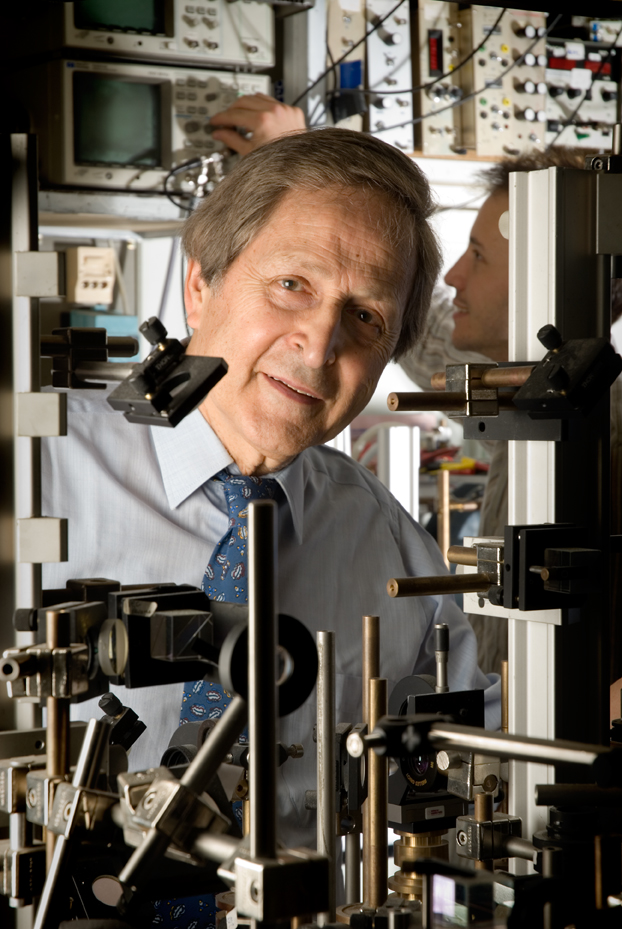
Claude Cohen-Tannoudji was born in Constantine in 1933. After attending a preparatory class in Algiers, he was admitted to the École normale supérieure in 1953. Initially drawn to mathematics, he was captivated by Alfred Kastler’s teaching and turned to physics. In 1955, he joined the group that Kastler had founded with his student Jean Brossel at the Laboratoire de Spectroscopie Hertzienne de l’ENS. This laboratory, now known as the Laboratoire Kastler Brossel within the ENS Physics Department, would remain Claude’s scientific home throughout his career.
After conducting his first research on the spectroscopy of atomic vapours, Claude prepared a doctoral thesis, which he defended in 1962 under the title Quantum Theory of the Optical Pumping Cycle: Experimental Verification of New Predicted Effects. This title epitomises a career that consistently combined theory and experiment. His work highlighted a phenomenon that was difficult to observe but would play a crucial role with the advent of lasers: light can shift the energy levels of an atom.
Further exploration of these questions led him to develop the dressed-atom approach with his students, particularly Serge Haroche. In this framework, the atom and the surrounding photon field form an inseparable whole, whose properties can be understood through its energy-level diagram. The full potential of this concept would become apparent later in Claude’s career, when he turned his attention to the possibility of cooling and trapping atoms using light.
In 1984, Claude established an experimental and theoretical research group dedicated to the physics of cold atoms, together with Alain Aspect, Jean Dalibard and Christophe Salomon. They were joined a few years later by Yvan Castin and subsequently by Michèle Leduc. Under his leadership, the group was at the forefront of several world firsts: the Sisyphus effect, which combines optical pumping and light shifts; cooling below the single-photon recoil limit; optical lattices created by standing light waves; the cold-atom fountain clock; and the optics and interferometry of matter waves. Claude’s research on light–matter interactions paved the way for numerous developments, particularly the study of Bose–Einstein condensates and superfluid Fermi gases.
Claude’s research career was inseparable from his passion for sharing knowledge. Appointed professor at the Faculty of Sciences in Paris at the age of 34, he worked with his colleagues Bernard Diu and Franck Laloë to develop a renewed approach to teaching quantum physics. This work gave rise to Quantum Mechanics, widely known as the “Cohen”, a landmark textbook that continues to educate generations of students. Six years later, in 1973, he was appointed professor at the Collège de France, where he taught for 31 years. Many remember his impeccably organised blackboards, his handwritten notes and his remarkably clear explanations. His lectures helped shape the entire French community working in quantum optics and atomic physics. Further books followed, covering quantum electrodynamics and matter–radiation interactions, written with Jacques Dupont-Roc, Gilbert Grynberg and David Guéry-Odelin. Beyond formal teaching, Claude was always willing to discuss ideas and share his knowledge with those who approached him. His generosity in inspiring others and fostering the dissemination of new ideas never wavered.
Claude lectured at numerous universities abroad and at international schools, including the École de physique des Houches. Throughout his career, he received many distinctions, too numerous to list in full here. Among them were his election to the French Academy of Sciences in 1981, where he would play an active role in defending persecuted scientists; the CNRS Gold Medal in 1996; and, crowning his career, the 1997 Nobel Prize in Physics, which he shared with Steven Chu and William D. Phillips. In Stockholm, Claude concluded his Nobel lecture with a quotation from Edmond Rostand: “It is in the night that it is beautiful to believe in the light.” These words perfectly captured his humanism
To learn more about Claude Cohen-Tannoudji:
https://www.lkb.fr/laboratoire/presentation/histoire/claude-cohen-tannoudji/
To send your condolences, pay tribute to Claude Cohen-Tannoudji, or express your support for his loved ones, you can write to the following address: souvenir.cct@lkb.ens.fr. All messages will be collected in his memory.
Read also
Using the colors of light to make optical computing more flexible
Authors: Xue Dong, Kai Lion, Fei Xia, YoonSeok Baek, Ziao Wang, Niao He et Sylvain Gigan
Random Matrices Predict the Organization of Matter
New publication in Nature Communications