
Research
Our group performs experimental and theoretical research at the interface of quantum information, quantum gas physics and microcavity technology. We are particularly interested in multi-particle entanglement in atomic systems and its applications to metrology. We are also involved in real life applications of the leading-edge technology that we develop for our research.
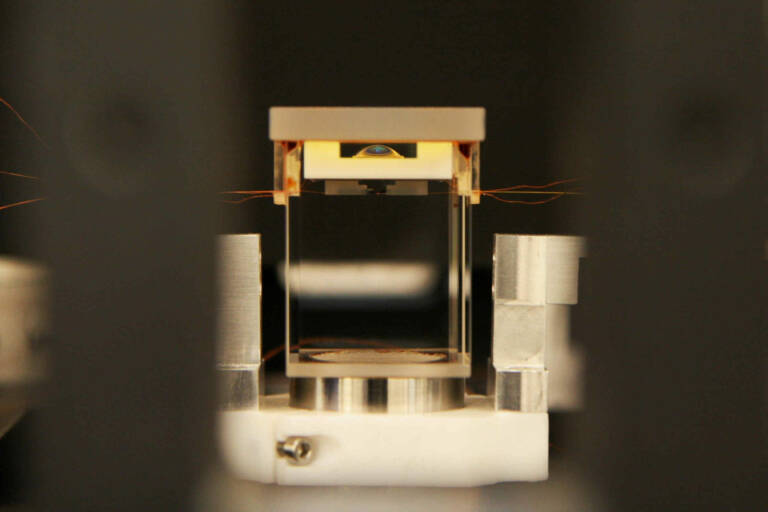
Rubidium CQED
Placing N qubit atoms in an optical cavity gives rise to a rich physical setting where highly entangled atomic states naturally arise. However, in most experiments so far, all atoms were permanently coupled to the cavity mode, and could be neither addressed nor read out individually. Our second-generation experiment “Sarocema” combines our successful fiber Fabry-Perot approach with atomic tweezers techniques, to realize a one-dimensional array of individually addressable atomic qubits in the cavity. This opens up the largely unexplored field of quantum simulations with long-range, cavity mediated interactions.
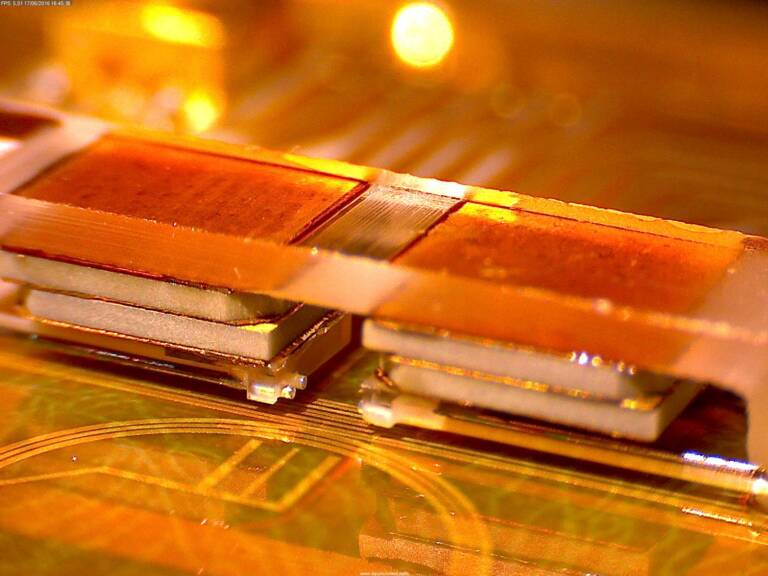
Trapped Atom Chips Clock (TACC)
TACC applies the innovative technique of atom chips, where atom cooling, trapping and interrogation are realised on a microchip. Lithographically structured gold wires carry DC currents for magnetic levitation as well as RF and microwave signals for atom cooling and interrogation. Utilising the power and low cost of micro-fabrication, this technique presents enormous potential for the realisation of embarked systems. In a 1st generation set-up, we have demonstrated a competitive clock stability of 5.8 10-13 at 1s [Szmuk et al arXiv:1502.03864].
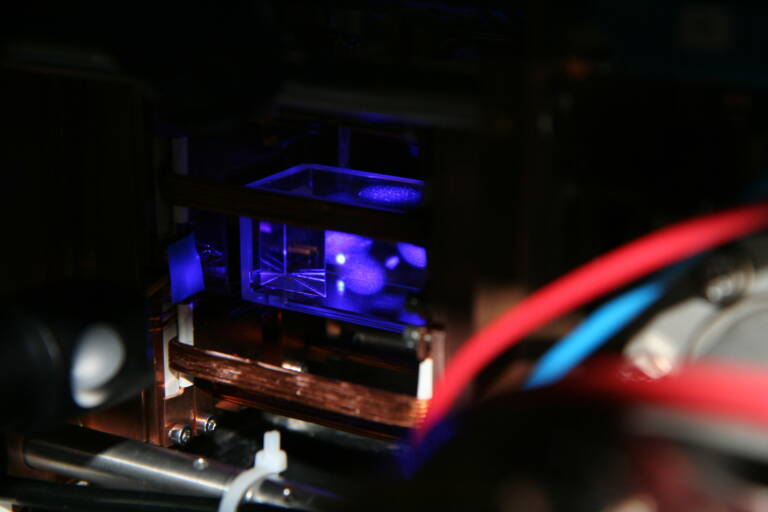
Strontium CQED
We are setting up an ultracold strontium experiment to combine attractive properties of alkaline-earth atoms with the interaction and measurement possibilities offered by cavity QED. This is feasible and extremely promising due to the recent progress in ultracold Sr experiments combined with a unique microcavity technology developed in our group. This will allow us to apply quantum metrology techniques to the transitions used in the best atomic clocks. In a second step, we will add a miniaturized quantum gas microscope on the intracavity optical lattice, opening exciting perspectives at the interface of quantum information and quantum gas physics.
This work is supported by the ERC Advanced Grant EQUEMI – Entanglement and Quantum Engineering with optical Microcavities.
Theory: Quantum gases and metrology
Our projects cover two main aspects of the physics of cold gases and atomic Bose-Einstein condensates. The first one concerns fundamental properties, such as phase coherence, correlations, and multimode finite temperature aspects. The second one is on the use of Bose-Einstein condensates and cold gases to create non-classical states of the atomic field that may be useful in metrology (spin-squeezed states), in probing the frontiers between the quantum and the classical world (Schrödinger cats) and for quantum information.
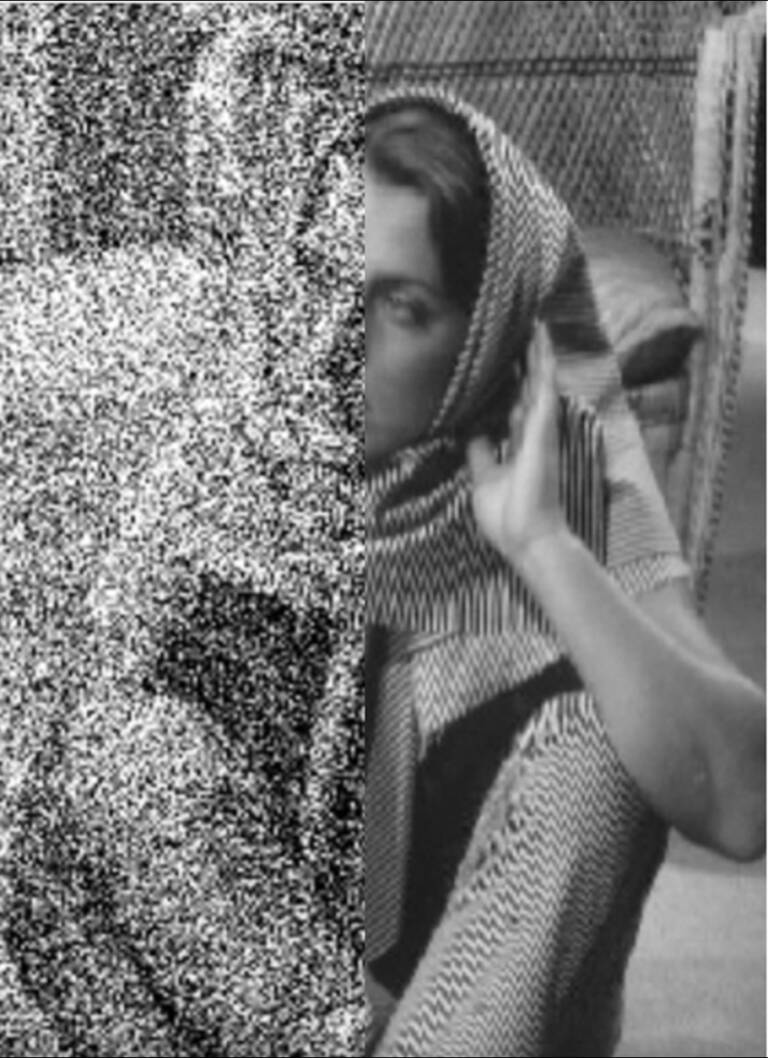
Figure: Reconstruction of an image with uncorrelated atoms (left half) or entangled atoms (right half). SciPost Physics 14, 050 (2023)
https://www.phys.ens.psl.eu/~sinatra/
Microcavity-enhanced trace gas detection
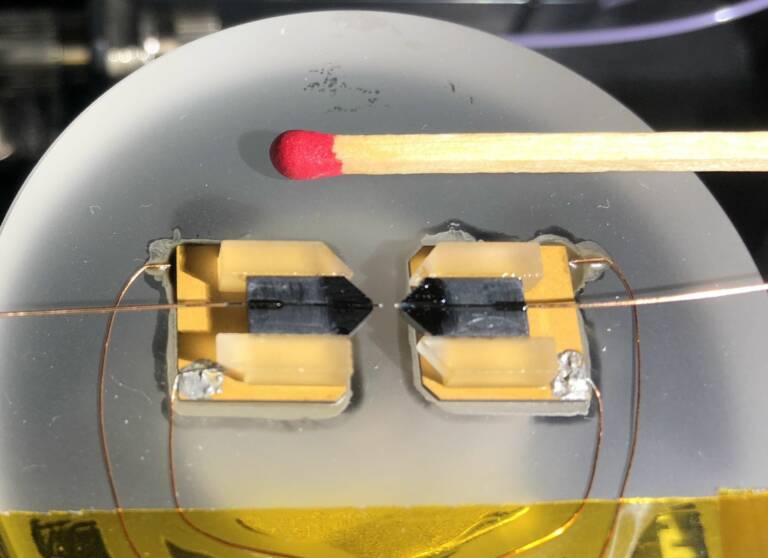
Cavity-enhanced laser spectroscopy is the gold standard for precise measurement of low gas concentrations, such as greenhouse gases. Yet, today’s trace gas analyzers are bulky devices, typically requiring stationary installation. Our fiber Fabry-Perot microcavities (FFPs) enable a miniature, portable and robust gas analyser that can be integrated in a hand-held device or mounted on a drone. It offers a combination of compactness and performance that does not exist in any commercial instrument today. With its sub-microliter analysis volume, it is also extremely fast and can cope with small gas samples. Furthermore, being fiber coupled by design, our analyser leverages the field-proven, cheap and high-performance toolset of telecom fiber optics.
News
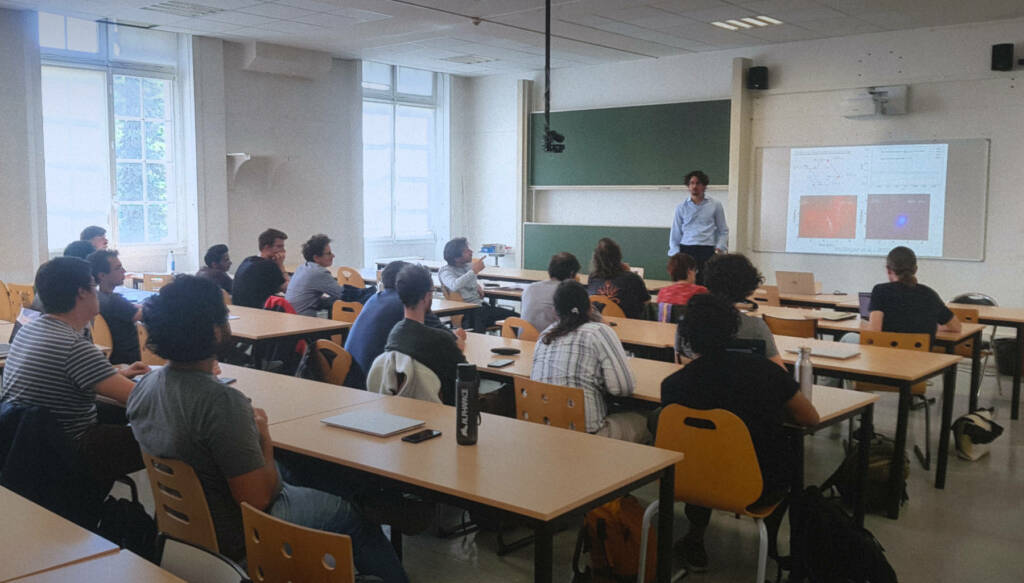
Paris-Basel seminar at Ecole normale supérieure
The 11th edition of the Paris-Basel seminar was held on May, 19th and 20th.
Mirega featured in french national economy journal
The startup company initiated from the team’s research has been featured in Challenges’ 100 start-ups to invest in in 2025.https://www.challenges.fr/entreprise/start-up/mirega-revolutionner-la-detection-des-fuites-de-gaz-a-effet-de-serre_601025 (in French).
MiTra receives ERC PoC grant
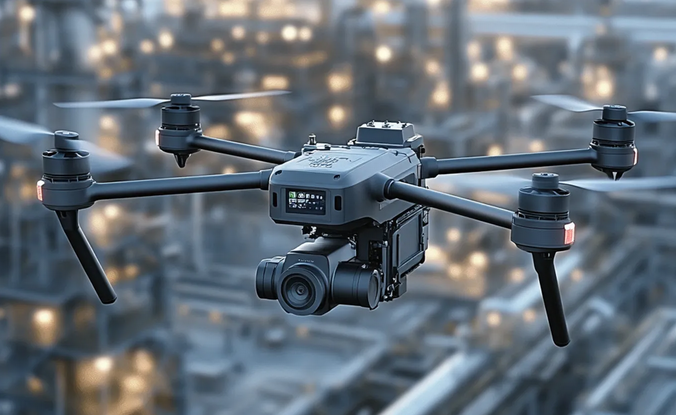
Our miniature greenhouse gas analyzer project has been awarded an ERC Proof-of-Concept (PoC) grant. This will boost our development of an ultracompact yet very accurate analyzer based on our fiber Fabry-Perot microcavity technology. It will measure the concentration of greenhouse gases with an accuracy and stability rivaling state-of-the art instruments, but in a handheld, drone-mountable form factor – less then one tenth the weight and one hundreth the volume of existing instruments.
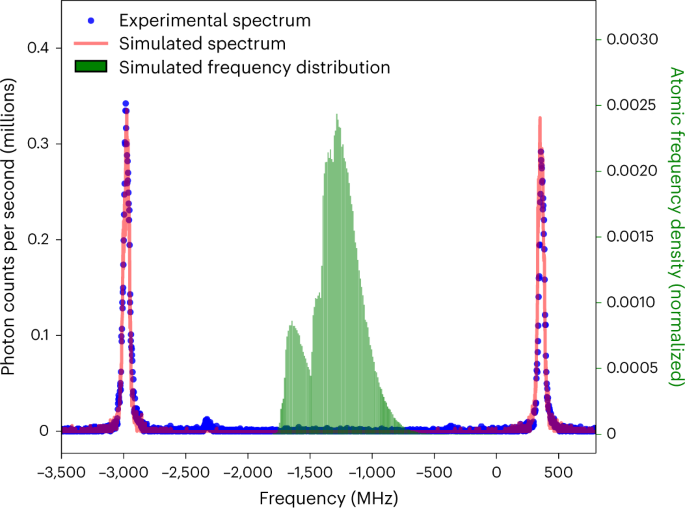
Spectral engineering of cavity-protected polaritons in an atomic ensemble
Our paper presenting the demonstration of spectral engineering of polaritons in a cold atom cavity system has been published in Nature Physics on May 2nd, 2023. You can read the full paper by accessing it here: https://rdcu.be/dbmX7
The team
Permanent researchers
The team is currently comprised of:
Jean Hare (Professor, Sorbonne Université);
Romain Long (Assistant Professor, Sorbonne Université);
Alice Sinatra (Professor, Sorbonne Université);
Jakob Reichel (Professor, Sorbonne Université), group leader.
PhD students, post-docs
Rubidium CQED experiment:
Marcel Kern, Thomas Picot, Clément Raphin
Theory:
Ali Moshiri
TACC:
Théo Sanchez (SYRTE)
Jobs
More content coming soon.