
- Home
- Laboratory
- Presentation
- News
- The adjustment of fundamental constants: a tool for new physics searches
The adjustment of fundamental constants: a tool for new physics searches

The values of fundamental constants such as the fine-structure constant, the mass of the electron or proton, the Rydberg constant, are determined by a variety of high-precision experiments: atomic spectroscopy or interferometry, mass spectrometry, g-factor measurements, etc. A constant or a combination of several constants may, depending on the case, be deduced directly from the experimental results or obtained via a comparison with the predictions of quantum electrodynamics (QED). A global adjustment of all available experimental and theoretical data, updated every 4 years by CODATA, determines the values of the fundamental constants.
Beyond the values of the constants, the quality of this adjustment represents a strong test of the consistency of the data set, and of the robustness of the Standard Model. In an international collaboration involving specialists in high-energy physics and atomic and molecular physics, we have been able to go a step further and use this procedure to probe for possible new physics [1]. We focused on minimal extensions of the Standard Model featuring an additional boson, weakly coupled to Standard Model particles (electrons, muons, light quarks), which would mediate a “fifth force”. At the leading order, this new interaction is represented by a potential whose form is well known (Yukawa potential) and whose range is inversely proportional to the boson’s mass.
Atomic or molecular spectroscopy, which makes a significant contribution to the dataset used by CODATA, is typically sensitive to interactions whose range is of the order of the Bohr radius – a large distance on the scale of particle physics. In other words, it would be sensitive to the existence of a light new particle: the Bohr radius corresponds to a mass of a few keV, or close to 1 MeV in the case of muonic atoms. In this sense, our research is complementary to that carried out at much higher energies (TeV) at CERN.
We have therefore reproduced the CODATA fitting procedure, adding to the theoretical predictions of the Standard Model the shifts induced by the hypothetical fifth force, whose coupling coefficient is treated as an adjustable parameter. Several representative models of the new particle (resulting in different relative strengths of couplings to electrons, muons and nucleons) have been studied. For each model, the fit provides strong constraints in a wide mass range.
Most interestingly, one of the studied models significantly improves the fit, and is favored over the standard model at the level of 5 standard deviations (see Figure). However, it would be premature to conclude that new physics has been detected. The imperfections observed in the Standard Model fit stem from tensions between several experiments involved in the determination of the proton charge radius (electron and muon hydrogen atom spectroscopy), which could be due to unknown or underestimated systematic effects. Nevertheless, our results demonstrate that this global fitting procedure is a sensitive tool in the search for new light physics.
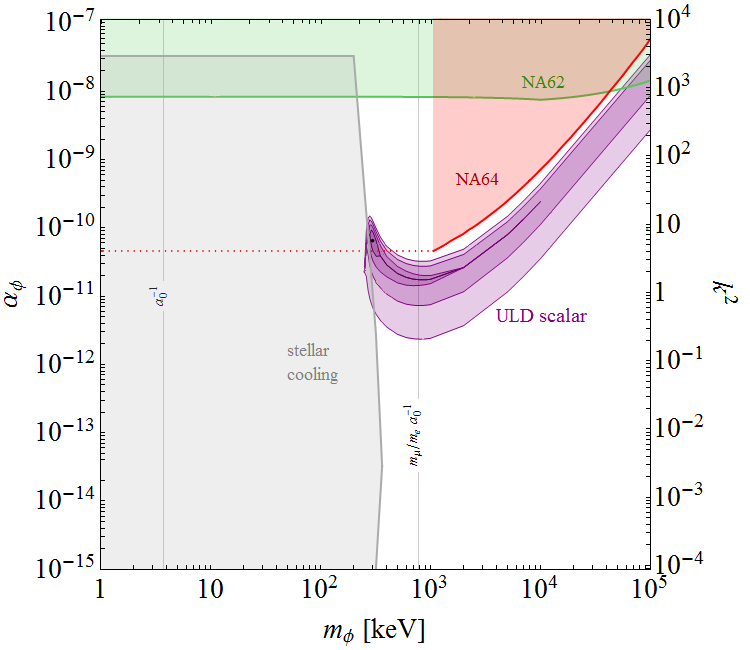
[1] Self-consistent extraction of spectroscopic bounds on light new physics
Cédric Delaunay, Jean-Philippe Karr, Teppei Kitahara, Jeroen C.J. Koelemeij, Yotam Soreq, Jure Zupan
Phys. Rev. Lett. 130, 121801 (2023) https://doi.org/10.1103/PhysRevLett.130.121801
Read also
Antimatter: coming soon to a lab near you?
News by Nancy Paul (co-author)
Glassblower at LKB – Tom Chevry
Interview published by Sciences Sorbonne Université

Shaking Atoms to Bring Black-Hole Quantum Chaos into the Lab
New publication led by Nathan GoldmanThis paper was selected as an Editors’ Suggestion in Physical Review Letters (PRL).