
- Home
- Laboratory
- Presentation
- News
- Non-destructive optical read-out and manipulation of circular Rydberg atoms
Non-destructive optical read-out and manipulation of circular Rydberg atoms
New publication from the Rydberg Atoms team : Yohann Machu, Andrés Durán-Hernández, Gautier Creutzer, Aurore Alice Young, Jean-Michel Raimond, Michel Brune, Clément Sayrin
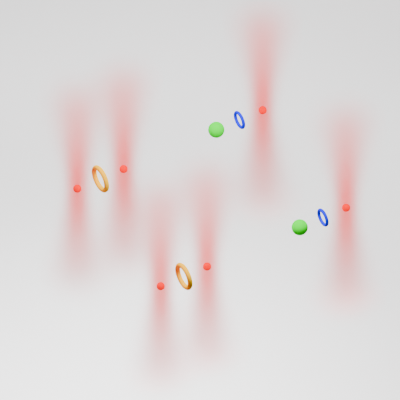
Credit: Clément Sayrin
The Rydberg atom team has developed a hybrid quantum platform enabling the non-destructive optical detection and individual manipulation of circular Rydberg atoms. These results overcome a major obstacle to the use of these ideal qubits — combining strong interactions with long lifetimes — in quantum computers, and pave the way for long-duration quantum simulations.
Quantum computing and quantum simulation platforms rely on individual quantum systems carrying information, known as qubits, which can occupy the state 0, the state 1, or any quantum superposition of the two. Ideally, these systems must be individually controllable and measurable, have long lifetimes, and interact strongly with one another.
Rydberg atoms — atoms prepared in highly excited states — satisfy these requirements rather well and have recently led to spectacular results, most often using states accessible through laser excitation from the ground state. This optical coupling enables individual control of atoms trapped in optical tweezers and arranged in arbitrary lattice geometries. However, the duration of computation or simulation has so far been limited by the lifetime of these ordinary Rydberg states. One possible solution is to use so-called “circular” Rydberg atoms, whose lifetime is at least 100 times longer. Yet these exotic atoms are completely insensitive to light, making their manipulation and detection extremely challenging.
In this work, we explore a hybrid platform that overcomes this technological barrier for the first time. It encodes data qubits in circular Rydberg states and couples them to auxiliary atoms that are transiently excited to a carefully chosen ordinary Rydberg state. The strong dipole-dipole interaction between the two atoms enables non-destructive quantum measurement of the state of individual circular qubits. To achieve this, the state of the qubit is transferred onto the auxiliary atom, whose state is then read out through optical fluorescence. Conversely, we optically manipulate the state of circular qubits by imprinting onto them the state of an auxiliary atom controlled by laser fields.
Our platform promises to significantly improve the performance of quantum simulators based on Rydberg atoms. It opens the way toward long-duration quantum simulations, enabling the observation of the dynamics of complex quantum systems and the study of slow phenomena that remain beyond the reach of current simulators and are particularly difficult to model numerically.
To learn more, arXiv.org: https://arxiv.org/abs/2509.24691
Machu, Y., Durán-Hernández, A., Creutzer, G., Young, A. A., Raimond, J., Brune, M., & Sayrin, C. (2025, 29 septembre). Non-destructive optical read-out and manipulation of circular Rydberg atoms.
Read also
Antimatter: coming soon to a lab near you?
News by Nancy Paul (co-author)
Glassblower at LKB – Tom Chevry
Interview published by Sciences Sorbonne Université
Shaking Atoms to Bring Black-Hole Quantum Chaos into the Lab
New publication led by Nathan GoldmanThis paper was selected as an Editors’ Suggestion in Physical Review Letters (PRL).