Using the colors of light to make optical computing more flexible
Authors: Xue Dong, Kai Lion, Fei Xia, YoonSeok Baek, Ziao Wang, Niao He et Sylvain Gigan
Optical computing systems use the propagation of light to process information rapidly and in parallel. However, most current architectures rely on a single wavelength, limiting them to a fixed optical transformation for a given configuration. In this study, we overcome this limitation by exploiting the wavelength dependence of the response of complex scattering media. By using different wavelengths, a single optical system can perform distinct transformations of the input information, generating independent optical representations without requiring any physical modification of the device. We show that combining these different spectral channels improves classification performance while also providing a direct estimate of prediction uncertainty. This approach opens up new possibilities for more versatile optical accelerators for artificial intelligence.
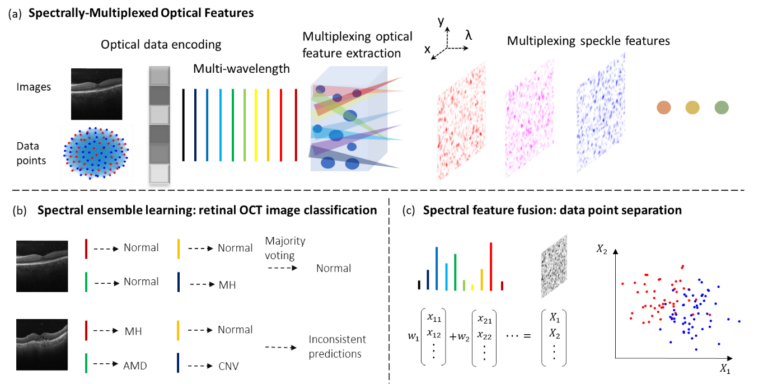
(a) Optical feature extraction setup: Light from a wavelength-tunable continuous-wave laser is directed onto a glass optical diffuser, generating distinct speckle patterns at each wavelength.
(b) Spectral ensemble learning: classification of retinal OCT images. Speckle patterns obtained at different wavelengths are processed independently using linear regression. The predictions from each wavelength are then combined through majority voting to obtain the final classification across eight retinal disease categories. The consistency of predictions across different wavelengths also makes it possible to estimate uncertainty: strong disagreements indicate higher uncertainty.
(c) Spectral feature fusion: data point separation. Speckle patterns obtained at multiple wavelengths are combined using weights that are adjusted during training to improve the separation of data points.
The rapid development of artificial intelligence is driving an ever-increasing demand for computing power and energy. Conventional electronic architectures are facing growing challenges related to data transfer, energy consumption and heat generation. Optical computing offers a promising alternative by harnessing the ability of light to naturally perform complex operations in parallel, potentially reducing processing times and energy consumption.
One approach is free-space optical computing, in which information is encoded onto a light beam and then transformed as it propagates through an optical system. For example, when a light beam carrying an input image passes through a scattering medium, such as a diffuser, the different spatial components of the optical field mix together, producing a complex pattern of bright and dark spots known as a speckle pattern. The light intensities recorded by a camera constitute high-dimensional optical features, providing a transformed representation of the original image that can be used by a digital classifier. Since these complex transformations occur directly as light propagates, they can be performed in parallel without requiring equivalent electronic computations, potentially reducing the computational load on conventional processors.
State of the art before this work
Many optical computing systems based on complex media have so far relied primarily on monochromatic illumination and a fixed optical configuration, meaning that the optical components and their arrangement remain unchanged. Although these systems can generate a large number of spatial features, corresponding to the light intensities measured at different camera pixels, their ability to adjust or diversify the optical transformation remains limited.
Main results
In this work, we exploit the wavelength dependence of the response of scattering media. The same input data can therefore produce different speckle patterns when illuminated at different wavelengths. These wavelength-dependent patterns can be regarded as independent optical representations of the same information.
We investigated two complementary approaches to harness this spectral diversity.
The first approach, called spectral ensemble learning, uses each wavelength to generate a different optical transformation and an independent prediction. The predictions obtained at several wavelengths are then combined through majority voting: each wavelength casts a vote for a category, and the category receiving the most votes becomes the final prediction. In a retinal image classification task, combining nine wavelengths increased classification accuracy from 50.14% to 55.00% using 1,000 features.
An additional advantage is that disagreement between predictions obtained at different wavelengths provides a direct measure of prediction uncertainty. This makes it possible to assess the level of confidence without requiring access to the model’s calibrated internal probabilities.
The second approach, called spectral feature fusion, combines optical features generated at different wavelengths using optimized weights before classification. In a texture classification experiment, combining nine wavelengths increased accuracy from 58% to 70%, while retaining a single final classifier.
Taken together, these results demonstrate that wavelength can provide an additional degree of freedom for optical computing, enhancing both the flexibility and computational capabilities of the system.
Experimental approach
The input data are first encoded onto a laser beam using a spatial light modulator. The beam then passes through an optical diffuser, which transforms the input information into a speckle pattern recorded by a camera.
The experiment is repeated at wavelengths ranging from 785 to 825 nm, in 5 nm increments. Since the diffuser responds differently to each wavelength, each one generates a distinct optical representation of the same input data.
The features obtained at multiple wavelengths are then processed in one of two ways: either independent classifiers are used for each wavelength, followed by majority voting, or features from several wavelengths are combined using optimized weights before a single classifier produces the final prediction.
Laboratories and institutions involved
This work involved researchers from:
Laboratoire Kastler Brossel (LKB) — École Normale Supérieure–PSL, Sorbonne Université, CNRS, UMR 8552, and Collège de France;
Department of Computer Science, ETH Zurich;
Department of Electrical Engineering and Computer Science, University of California, Irvine.
The article was published in Optica, volume 13, issue 10, on October 1, 2026.
Outlook
The current experimental prototype acquires the different wavelengths sequentially, but this limitation is not fundamental to the concept. In future implementations, several wavelengths could be transmitted and processed simultaneously using wavelength-division multiplexing technologies already widely used in optical telecommunications.
At the output, the different wavelengths could also be separated and detected in parallel, enabling multi-wavelength optical processing within a single acquisition.
Future work could also explore full optical field measurement, which would offer greater flexibility in combining optical features, as well as extending this approach to nonlinear optical systems capable of generating even richer representations for machine learning applications.
Credit:
Xue Dong, Kai Lion, Fei Xia, YoonSeok Baek, Ziao Wang, Niao He and Sylvain Gigan, Optica 13, 2056–2065 (2026), DOI: 10.1364/OPTICA.589581.
Publication information
Article title: Optical Computing with Spectrally Multiplexed Features in Complex Media
Authors: Xue Dong, Kai Lion, Fei Xia, YoonSeok Baek, Ziao Wang, Niao He and Sylvain Gigan.
Publication date: October 1, 2026
Journal: Optica, Vol. 13, No. 10
DOI: 10.1364/OPTICA.589581
Read also
Random Matrices Predict the Organization of Matter
New publication in Nature Communications

Claude Cohen-Tannoudji has passed away
It is with deep sadness that we learned of the death of Claude Cohen-Tannoudji, on 22 October.