Random Matrices Predict the Organization of Matter
New publication in Nature Communications
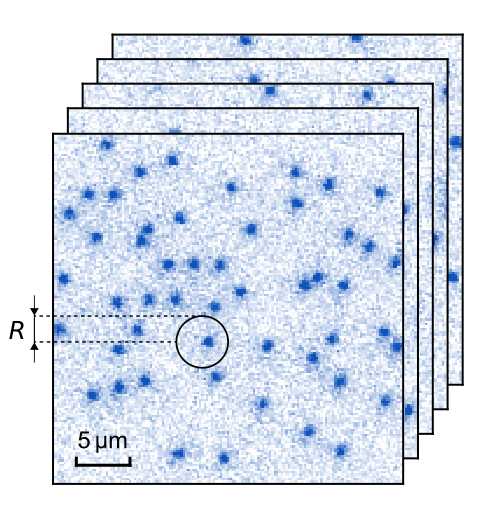
A scientific collaboration led by Tarik Yefsah (Laboratoire Kastler Brossel, LKB), Pierre Le Doussal (Laboratoire de Physique de l’École Normale Supérieure, LPENS), and Grégory Schehr (Laboratoire de Physique Théorique et Hautes Énergies, LPTHE), together with their respective teams, has characterized how fermionic atoms organize themselves in a gas by measuring their counting statistics, and have shown that the resulting probability distributions follow very closely the laws described by random matrix models, even when interactions are present between the atoms.
What do the creation of new elements in stars, fluctuations in stock prices, and wireless data transmission have in common? To describe these three phenomena, physicists use the theory of random matrices: grids of numbers that statistically describe complex phenomena, allowing us to identify commonalities among them and reveal universal behaviors. This theory, initially applied by Wigner to describe the energy levels of heavy atomic nuclei, has found and continues to find numerous applications in physics, biology, and neuroscience.
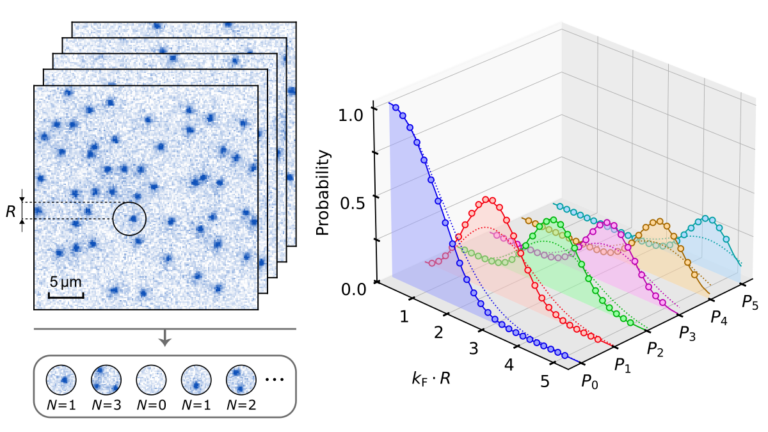
In an article to be published in Nature Communications, researchers at the Laboratoire Kastler Brossel have demonstrated, through unprecedented measurements, that the theory of random matrices can notably be encountered in a gas of cold atoms. These atoms (lithium-6) are fermions: the Pauli exclusion principle, a fundamental rule of quantum mechanics, strictly prohibits them from occupying the same physical state. Beyond the fact that two identical fermions cannot be found in the same place, this rule influences what scientists call the counting statistics: for a circle of a given radius, these are all the probabilities of observing zero, one, two, three… fermions inside the circle. These statistics are notoriously different for fermions than what one would obtain for classical objects (for example, by tipping a bag of marbles onto the floor). Although it has been known for decades that random matrix theory can predict these statistics, they had never before been measured directly, atom by atom.
To measure these probabilities, the researchers used a quantum simulator in which clouds of atoms are cooled to temperatures close to absolute zero. The quantum gas microscope technique, which they have previously developed for these systems, allowed them to detect the position of each atom within the gas. They were then able to count the atoms to deduce the probabilities, with an accuracy of one-hundredth of a percent. This allowed them to compare the data with advanced theoretical calculations and confirm the agreement between the predictions of random matrix models and the arrangement of fermions in space. By increasing the temperature of the gas, they were also able to observe how thermal motion destroys quantum correlations and how the organization of the gas reverts to a classical state, connecting the counting statistics in the deeply degenerate quantum regime to those of classical marbles on the same experiment.
Unexpectedly, they observed that the theoretical results for random matrices, which apply to non-interacting fermions, remain relevant for describing a gas in which two families of fermions interact strongly with one another. These results demonstrate the value of these microscopic-scale measurements for better understanding strongly correlated systems.
Références :
Universal Random Matrix Behavior of a Fermionic Quantum Gas, Maxime Dixmerias, Giuseppe Del Vecchio Del Vecchio, Cyprien Daix, Joris Verstraten, Tim de Jongh, Bruno Peaudecerf, Pierre Le Doussal, Grégory Schehr, Tarik Yefsah, published in Nature Communications.
This research was conducted at the following CNRS laboratories:
- Laboratoire Kastler Brossel (LKB, CNRS/Collège de France/ENS-PSL/Sorbonne Université)
- Laboratoire de Physique Théorique et Modèles Statistiques (LPTMS, CNRS/Université Paris-Sud/Université Paris-Saclay)
- Laboratoire Collisions Agrégats Réactivité, (LCAR, CNRS/Université de Toulouse)
- Laboratoire de Physique de l’Ecole Normale Supérieure (LPENS, CNRS/ENS/PSL University/Sorbonne Université/Université Paris Cité)
- Laboratoire de Physique Théorique et Hautes Energies (LPTHE, CNRS/Sorbonne Université)
Contact :
Tarik Yefsah
CNRS Research Scientist at the Kastler Brossel Laboratory (LKB)
Read also
Claude Cohen-Tannoudji has passed away
It is with deep sadness that we learned of the death of Claude Cohen-Tannoudji, on 22 October.