
- Home
- Laboratory
- Presentation
- News
- “Le Monde” – Optical component enables efficient neural network training
“Le Monde” – Optical component enables efficient neural network training
New publication: Sylvain Gigan is a co-author
Read the article in Le Monde : https://www.lemonde.fr/sciences/article/2026/06/04/un-composant-optique-parvient-a-entrainer-efficacement-un-reseau-de-neurones_6697085_1650684.html
Training giant neural networks with light: a breakthrough beyond silicon to overcome the memory wall
An international team led by the Kastler Brossel Laboratory (Sorbonne University, ENS-PSL, CNRS, Collège de France) and the company LightOn has developed a novel optical learning method. Published in the journal PNAS, this approach exploits the propagation of light in disordered media to bypass the memory limitations of current electronic processors. It thus makes it possible to train very large artificial intelligence models dramatically faster and with significantly lower energy consumption.
Context and Problem: The Backpropagation Bottleneck
Today, training artificial intelligence systems relies almost exclusively on the backpropagation algorithm. While mathematically optimal, this method suffers from a major hardware limitation: it requires storing all activation signals from the forward pass in memory in order to compute updates during the backward pass. For modern foundation models (such as LLMs), this memory requirement grows exponentially and quickly saturates GPU RAM, forcing engineers to rely on software workarounds that significantly slow down computation (such as offloading techniques).
The Breakthrough: Optical Direct Feedback Alignment (ODFA)
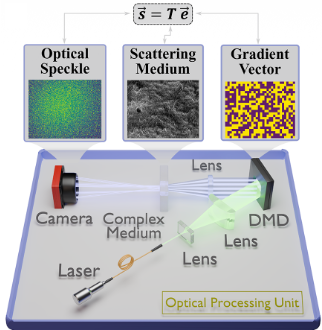
To overcome this limitation, the researchers replaced backpropagation with an alternative algorithm called Direct Feedback Alignment (DFA). Instead of propagating the error layer by layer, DFA directly projects the global error signal to each hidden layer using a random projection matrix. The key innovation of this publication is the physical and optical implementation of this random projection (Optical DFA). Instead of computing this expensive matrix multiplication electronically, the researchers use an optical coprocessor (OPU). A laser beam encoding the error signal passes through a disordered (opaque) optical medium. The fundamental physics of waves does the rest: multiple interferences instantly generate a high-dimensional random projection. The operation occurs at the speed of light and with near-zero energy consumption.
Results and Outlook: An Unprecedented Scale-Up
The published results show that the ODFA approach preserves excellent learning performance while enabling a level of scalability that electronics can no longer achieve.
- Processing capacity: The OPU can train neural layers of massive dimensionality (up to 45,000 × 45,000 parameters), a regime in which GPUs systematically run out of memory.
- Speed: In these very high-dimensional regimes, the optical projection runtime remains constant, making training up to 50 times faster than purely electronic simulation.
This breakthrough demonstrates that photonic computing in complex media is not only a speed accelerator, but also a structural solution for designing fundamentally different and more sustainable machine learning architectures.
Next Steps and Applications: Toward “Frugal” and Decentralized AI
While this proof of concept marks a scientific turning point, the next step for the team is to extend this optical architecture to the most complex current AI models, such as transformers (the architecture behind large language models). On the hardware side, the challenge will be to accelerate the interfaces between electronics and light (modulators and cameras) to maximize speed gains. In the longer term, this technology opens the way to “Green AI.” By drastically reducing memory and energy requirements for the critical training phase, photonics could not only reduce the exponential carbon footprint of data centers, but also enable large-scale, decentralized, and continuous learning directly on resource-limited systems (edge AI), where silicon alone currently fails.
Publication reference
Z. Wang, K. Müller, et al. Streamlined optical training of large-scale modern deep learning architectures with direct feedback alignment. Submitted and accepted to Proceedings of the National Academy of Sciences (PNAS). Preprint: arXiv:2409.1296
https://www.pnas.org/doi/10.1073/pnas.2532022123
Read also
Glass Technology for Quantum Research
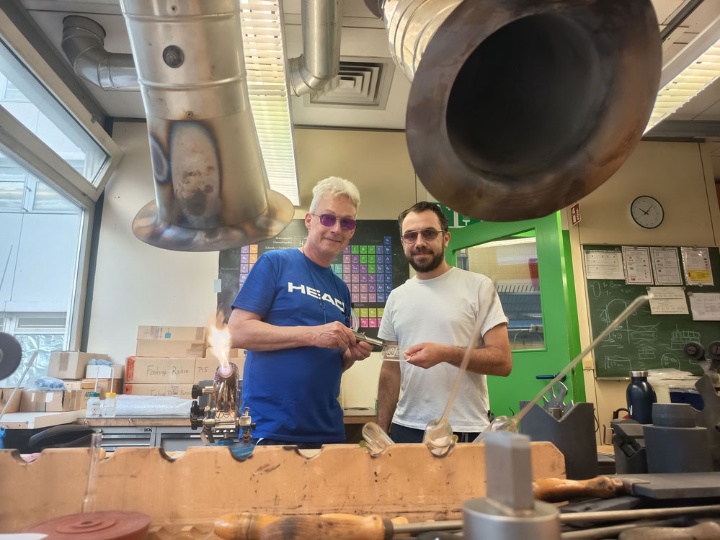
Glass technicians from Stuttgart and Paris exchange specialized techniques.[Article written by the University of Stuttgart.]
Non-destructive optical read-out and manipulation of circular Rydberg atoms
New publication from the Rydberg Atoms team : Yohann Machu, Andrés Durán-Hernández, Gautier Creutzer, Aurore Alice Young, Jean-Michel Raimond, Michel Brune, Clément Sayrin
The quantum key to seeing through chaos
New publication by Sylvain Gigan (LKB), Baptiste Courme (LKB), Hugo Defienne (INSP), Daniele Faccio (University of Glasgow), Chloé Vernière (INSP), Malo Joly and Raphael Guitter (co-authors)
