
Fundamental constants: the molecular hydrogen ion joins the play
A collaboration between researchers from Vrije Universiteit, LKB and the Joint Institute for Nuclear Research determined the proton-electron mass ratio with 11 significant digits !
The HD+ molecule, composed of a proton, a deuteron and an electron, is along with its isotopes such as H2+ or D2+, the simplest molecule. As such, it is a valuable tool to test our understanding of nature and to determine certain fundamental constants, similarly to studies carried out in the hydrogen atom.
These molecules make it possible to explore additional physical parameters. For example, since the vibration frequency of a molecule depends on the mass of its nuclei, the comparison between theory and experiment on vibrational transitions can be used to determine these masses.
Using this principle, a collaboration between researchers from Vrije Universiteit (Amsterdam), LKB and the Joint Institute for Nuclear Research (Dubna, Russia) determined the proton-electron mass ratio with 11 significant digits, an accuracy exceeding for the first time that of more traditional mass spectrometry methods.
Two ingredients were necessary to obtain this result. On the one hand, the experiment carried out in Amsterdam, which uses a novel Doppler-free two-photon spectroscopy scheme on ultra-cold trapped ions. On the other hand, the quantum electrodynamics (QED) calculations in these simple molecules, developed by French and Russian researchers, which reached a precision similar to the experimental one. To achieve this, the various QED correction terms were obtained analytically, then computed numerically on the LKB and JINR clusters, where some terms required several weeks of computation time.
The obtained value of the mp/me ratio is in excellent agreement with the latest mass spectrometry measurement of the proton mass (see Fig. 1). In the future, in conjunction with other measurements in HD+ and H2+, these results may be used to constrain the existence of a possible “fifth force” between hadrons and give new insight on other fundamental constants such as the Rydberg constant and the proton radius.
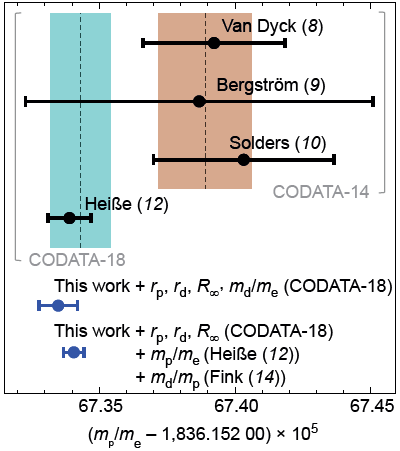
Full article : Sayan Patra, M. Germann, J.-Ph. Karr, M. Haidar, L. Hilico, V. I. Korobov, F. M. J. Cozijn, K. S. E. Eikema, W. Ubachs, J. C. J. Koelemeij, Proton-electron mass ratio from laser spectroscopy of HD+ at the part-per-trillion level, Science 369, 1238 (2020).
To be followed :article from the University of Evry and a portrait of Jean-Philippe Karr.
Read also
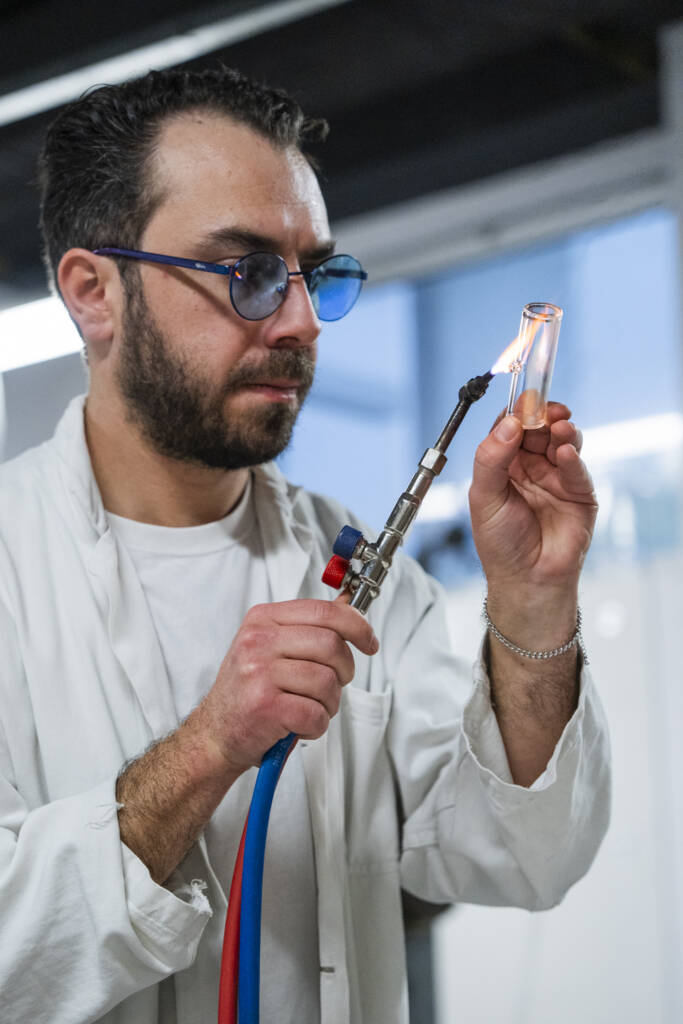
Glassblower at LKB – Tom Chevry
Interview published by Sciences Sorbonne Université
Shaking Atoms to Bring Black-Hole Quantum Chaos into the Lab
New publication led by Nathan GoldmanThis paper was selected as an Editors’ Suggestion in Physical Review Letters (PRL).
Mattia Walschaers: 2025 recipient of the Fabry-De Gramont Prize
By the Société Française d’Optique (SFO)