
Dark-soliton molecules in a polariton superfluid
Experiments performed the Quantum Optics team show that dark solitons in a quantum fluid of polariton quasiparticles can bind together to form a soliton molecule
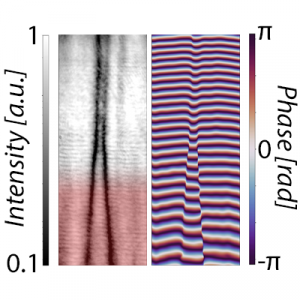
Solitons are localized waves propagating with unchanged shape in a nonlinear medium. Since their first observation in shallow waters, solitions have been observed in many different physical systems. Solitons can be bright, with a localized bump, or dark, with a dip on a homogeneous background. In this work, we use a novel all-optical technique to imprint dark solitons in a type of quantum fluid and find that two dark solitons can bind together to form a “dark-soliton molecule.”
Bright solitons are known to attract or repel each other, but previous work has shown that dark solitons experience only mutual repulsive forces, except in media with non-local long-range interactions. Our work shows this is not always the case: dark solitons can attract one another in media with local interactions as well.
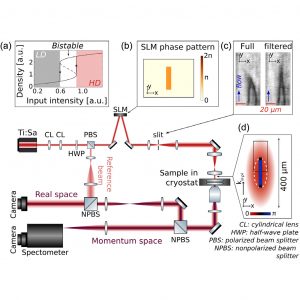
In our experiments, the medium is a quantum fluid of polaritons, quasiparticles composed of a photon coupled to an electric dipole. We show that two dark solitons can be imprinted parallel to each other and bound to form a stable “molecule,” which propagates on the fluid over macroscopic distances.
Our results are a significant advance in the understanding of non-linear phenomena in out-of-equilibrium quantum fluids, and our all-optical technique opens a way to the systematic study of quantum turbulence.
Article : https://doi.org/10.1103/PhysRevX.10.041028
Read also
Antimatter: coming soon to a lab near you?
News by Nancy Paul (co-author)

Glassblower at LKB – Tom Chevry
Interview published by Sciences Sorbonne Université

Shaking Atoms to Bring Black-Hole Quantum Chaos into the Lab
New publication led by Nathan GoldmanThis paper was selected as an Editors’ Suggestion in Physical Review Letters (PRL).