
Glass Technology for Quantum Research
Glass technicians from Stuttgart and Paris exchange specialized techniques.
[Article written by the University of Stuttgart.]
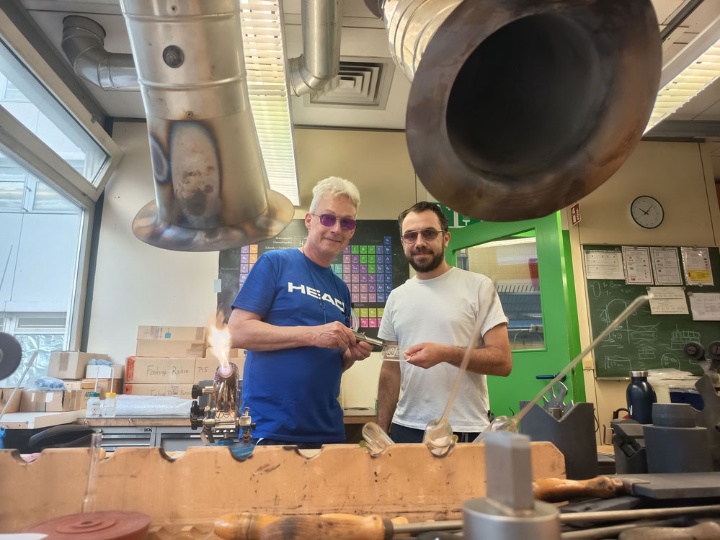
Image: Universität Stuttgart, 5. Physikalisches Institut
The flame hisses softly as the glass slowly takes shape under Frank Schreiber’s skilled hands. A few micrometers determine whether a cell will function later in the experiment or become unusable. In the glass technology workshop of the Institute of Physics at the University of Stuttgart, precision work is carried out for basic research—often invisible to outsiders, yet indispensable for many experiments.
Exchange between two long-established research institutions
The workshop was recently the focus of a special international exchange: From May 28 to 29, glass technician Frank Schreiber hosted a visit from his French colleague Tom Chevry, who runs the institute’s glass workshop at the renowned Laboratoire Kastler Brossel at Sorbonne University in Paris. The goal of the meeting was to exchange techniques, experiences, and specialized processes—particularly regarding the production of high-precision glass cells, which play a crucial role in experiments with photons or hot atoms in quantum optics.
“When people think of glassblowing, they often think of arts and crafts first. In reality, however, we often work here with tolerances of just a few hundredths of a millimeter,” explains Stuttgart-based glass technician Frank Schreiber. “Especially with vacuum cells or atomic vapor cells, every detail has to be just right, otherwise the experiments won’t work later on. Precision glass technology requires years of experience, which is very rare to find these days,” emphasizes Tilman Pfau, director of the 5th Institute of Physics.
When precision determines the success of an experiment
During the visit, special attention was paid to the various drilling and grinding processes and the so-called bonding techniques. In these processes, structures are milled or drilled into different materials such as glass, quartz, or silicon and permanently bonded into vacuum-sealed cells. Such processes are crucial for modern quantum technologies, for example when manufacturing miniaturized cells for photonic components or quantum sensors.
Tom Chevry, Schreiber’s colleague from Paris, emphasizes the importance of direct exchange: “Every workshop develops its own tricks over the years. When you work together and watch each other, you learn things that you can’t pick up from any manual.” He was particularly impressed by a technique from Stuttgart that allows custom-made structures to be incorporated into the delicate glass cells.
In Stuttgart, as in Paris, the glassblowers work closely with scientists. Tilman Pfau emphasizes that this close, intensive collaboration would not be possible at all with companies. New equipment is often developed through multiple iterations—tailored to the increasingly demanding experiments of quantum physics. “We essentially develop the components together with the researchers,” says Frank Schreiber. “Sometimes there are only a few workshops worldwide that can even manufacture certain components,” reports Robert Löw, who helped initiate the experiments with atomic vapor cells at the institute in Stuttgart.
The work of glass technicians remains indispensable for basic research. For before laser beams strike atoms or quantum effects become visible, one thing is often needed first: perfectly crafted glass cells.
Deep-rooted ties between Stuttgart and Paris
The fact that the exchange between Stuttgart and Paris goes far beyond purely technical cooperation is also demonstrated by the scientific connection between the two institutes: Alban Urvoy, who completed his master’s degree at the University of Stuttgart and earned his doctorate at the 5th Institute of Physics, is now a professor at Sorbonne University and has established contact between his French colleagues and their Stuttgart counterparts in research and the workshop. Today, he conducts research in Paris on quantum optics and quantum networks—building on scientific relationships that have grown over many years.
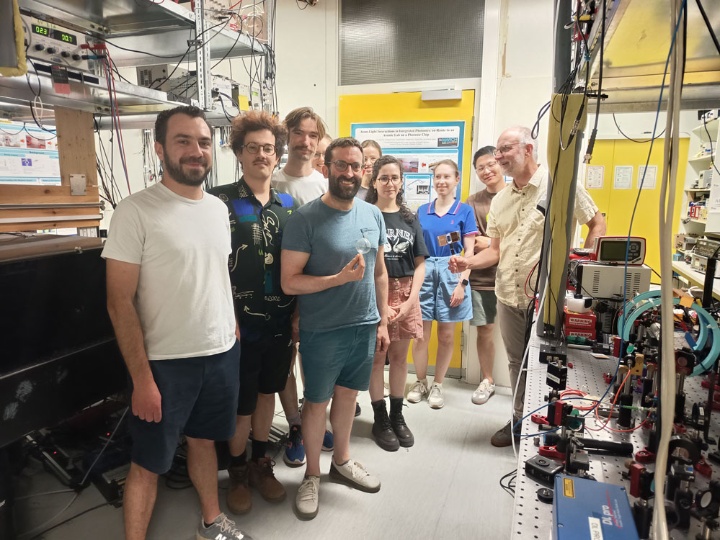
Image: Universität Stuttgart, 5. Physikalisches Institut
University of Stuttgart article : https://www.pi5.uni-stuttgart.de/news/Glass-Technology-for-Quantum-Research/
Read also
Antimatter: coming soon to a lab near you?
News by Nancy Paul (co-author)
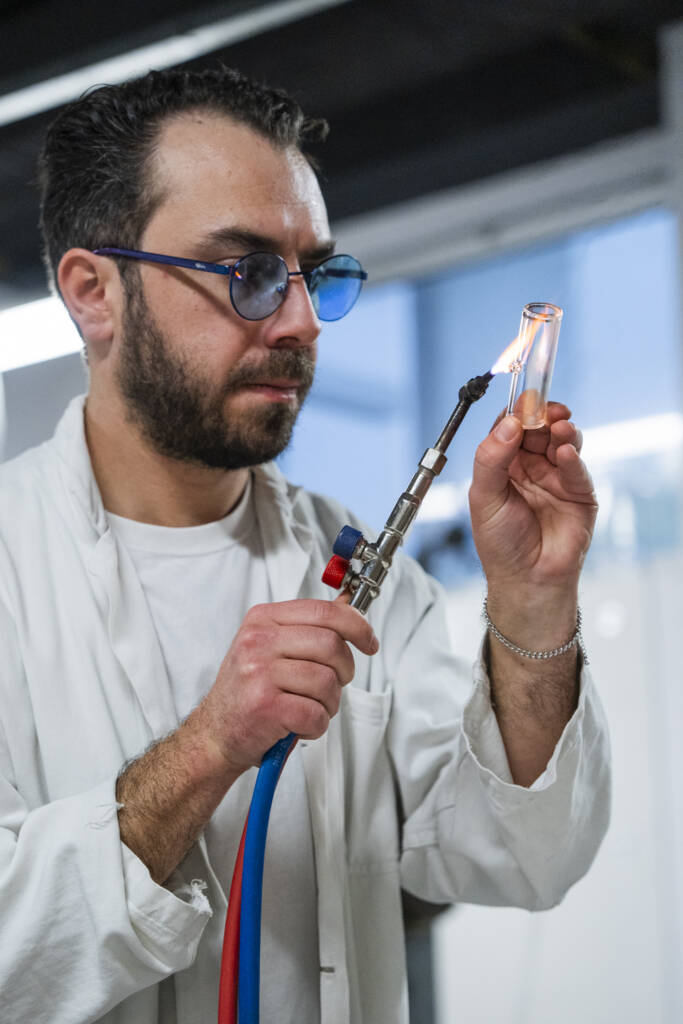
Glassblower at LKB – Tom Chevry
Interview published by Sciences Sorbonne Université
Shaking Atoms to Bring Black-Hole Quantum Chaos into the Lab
New publication led by Nathan GoldmanThis paper was selected as an Editors’ Suggestion in Physical Review Letters (PRL).