
Anomalous decay of coherence in a dissipative many-body system
Our work shows that strong interactions drastically modify the picture and lead to a slowing down of the decoherence process associated with a universal power-law decay.
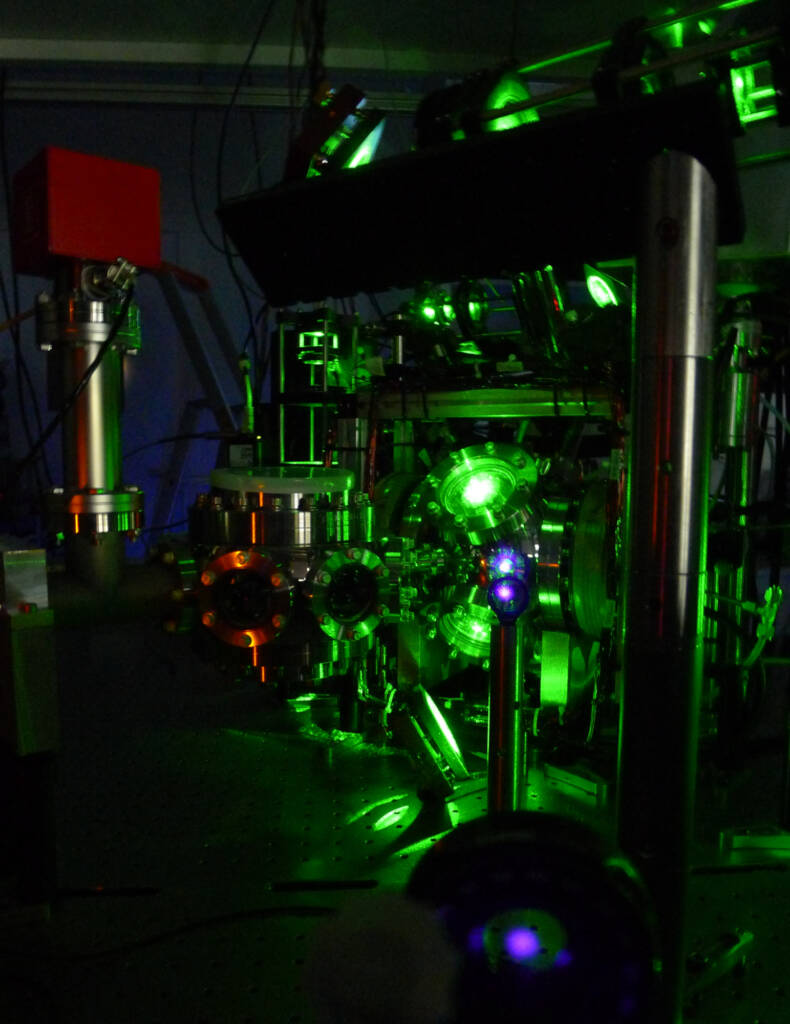
Bose-Einstein condensates team of our lab study the loss of spatial coherence of bosonic atoms in an optical lattice when subjected to a controlled amount of spontaneous emission. Ytterbium atoms are promoted to an excited state by a near-resonant laser and decay back to the ground state by spontaneous emission. A non-interacting system would correspond to the textbook example of radiative decay, and to an exponential decay in time of the spatial coherence.
Our work shows that strong interactions drastically modify the picture and lead to a slowing down of the decoherence process associated with a universal power-law decay.
Link to the full article : https://www.nature.com/articles/s41567-019-0678-2

Read also
Antimatter: coming soon to a lab near you?
News by Nancy Paul (co-author)
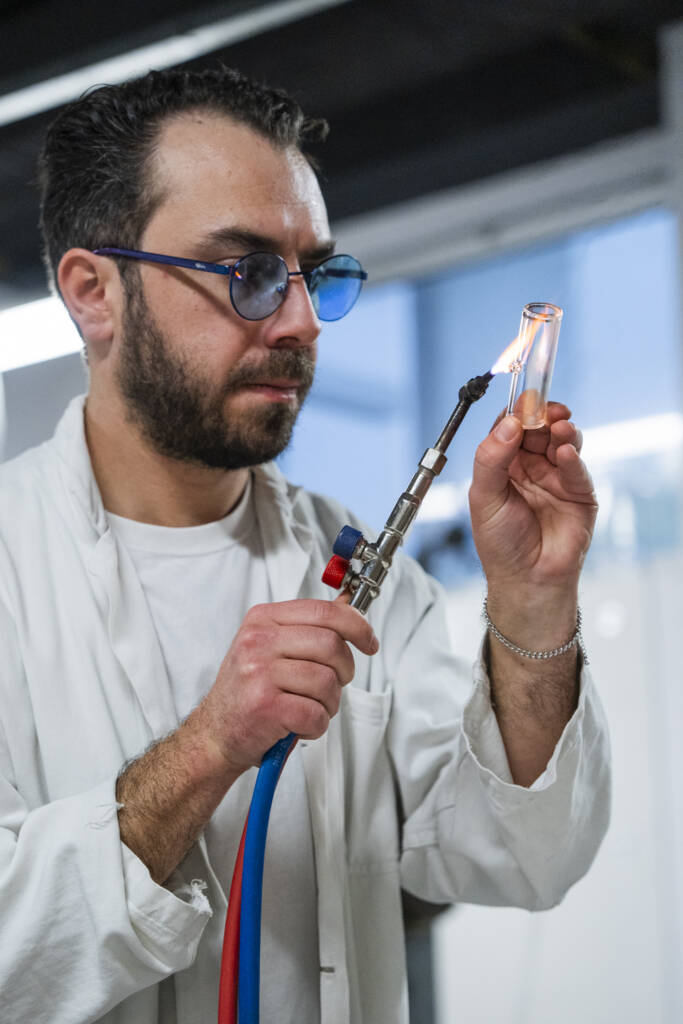
Glassblower at LKB – Tom Chevry
Interview published by Sciences Sorbonne Université
Shaking Atoms to Bring Black-Hole Quantum Chaos into the Lab
New publication led by Nathan GoldmanThis paper was selected as an Editors’ Suggestion in Physical Review Letters (PRL).