
- Accueil
- Laboratory
- Presentation
- News
- A new breakthrough improves nuclear material monitoring using ultra-precise quantum sensors
A new breakthrough improves nuclear material monitoring using ultra-precise quantum sensors
New publication: Paul Indelicato is a co-author
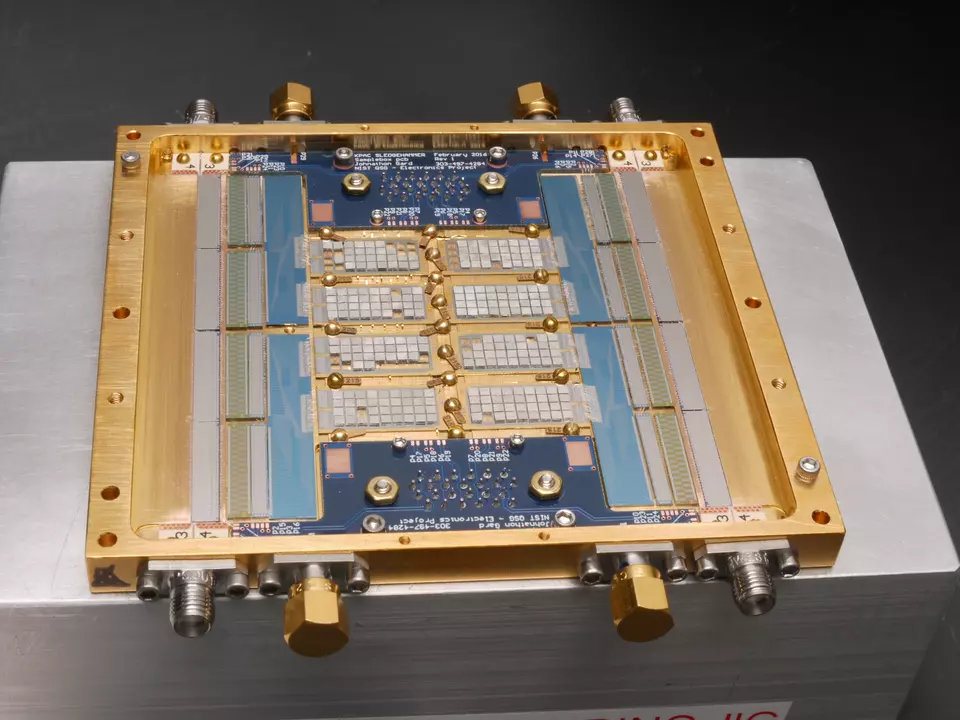
Credit: NIST
Researchers from the National Institute of Standards and Technology (NIST) and their collaborators have made the most precise measurements to date of the X-rays emitted by plutonium, uranium and neptunium. This breakthrough could strengthen international nuclear security while also improving the efficiency of nuclear power plants.
Monitoring nuclear materials relies in part on detecting the characteristic gamma radiation emitted by each radioactive element. However, these signals are often affected by X-rays emitted in the same energy range, making it more difficult to accurately identify and quantify nuclear materials.
To overcome this challenge, an international team of researchers from NIST, the University of Colorado Boulder, Los Alamos National Laboratory, Houghton University (NY), and the Laboratoire Kastler Brossel has measured the X-ray emissions of plutonium, uranium and neptunium with unprecedented precision. These new data will enable scientists to better distinguish between different radioactive signals and obtain more reliable estimates of nuclear material inventories.
At the heart of this breakthrough are next-generation quantum sensors known as Transition Edge Sensors (TES). Operating at temperatures close to absolute zero, these detectors act as extremely sensitive thermometers capable of measuring the energy of each X-ray photon with exceptional resolution. Thanks to this technology, measurement uncertainties have been significantly reduced compared with previous methods.
This work was published in Physical Review Letters on September 10, 2026. Read the publication
Paul Indelicato, from the Laboratoire Kastler Brossel, carried out relativistic atomic-structure calculations to predict the energy and width of the possible transitions. This made it possible to model the observed spectral lines and interpret the measured spectra. This work was carried out using a program he has been developing for many years. Learn more about the program
This improved measurement capability makes it easier to identify the isotopes present in nuclear materials. Such information is essential for distinguishing fuel intended for electricity generation from materials that could potentially be used for military purposes.
Beyond security and non-proliferation, this innovation could also benefit the nuclear industry. Faster and more accurate fuel analyses could accelerate certain stages of the nuclear fuel cycle, potentially improving operational efficiency and reducing costs for nuclear power plant operators.
The researchers are now continuing their work to further improve the performance of these detectors and miniaturize the associated cooling systems. In the long term, these developments could facilitate their deployment in a wider range of nuclear facilities and research centers around the world.
“Our measurements contribute to strengthening international nuclear safeguards by enabling more precise monitoring of the materials present in nuclear facilities,” says Jonathan Dean, a physicist at NIST and the University of Colorado Boulder.
For more information:
- Physical Review Letter : https://journals.aps.org/prl/abstract/10.1103/tcbz-kqk1
- NIST : https://www.nist.gov/news-events/news/2026/09/nist-developed-quantum-sensors-improve-nuclear-monitoring
- C&EN : https://cen.acs.org/physical-chemistry/nuclear-chemistry/nist-superconducting-heat-sensor-tracks-x-ray-emissions-nuclear-materials/104/web/2026/09
- Science Sorbonne Université : https://sciences.sorbonne-universite.fr/actualites/la-surveillance-des-matieres-nucleaires-amelioree-grace-des-capteurs-quantiques-ultra
Read also
Antimatter: coming soon to a lab near you?
News by Nancy Paul (co-author)
Glassblower at LKB – Tom Chevry
Interview published by Sciences Sorbonne Université

Shaking Atoms to Bring Black-Hole Quantum Chaos into the Lab
New publication led by Nathan GoldmanThis paper was selected as an Editors’ Suggestion in Physical Review Letters (PRL).