
Simplest Molecules Test Quantum Theory
Jean-Philippe Karr is the co-author
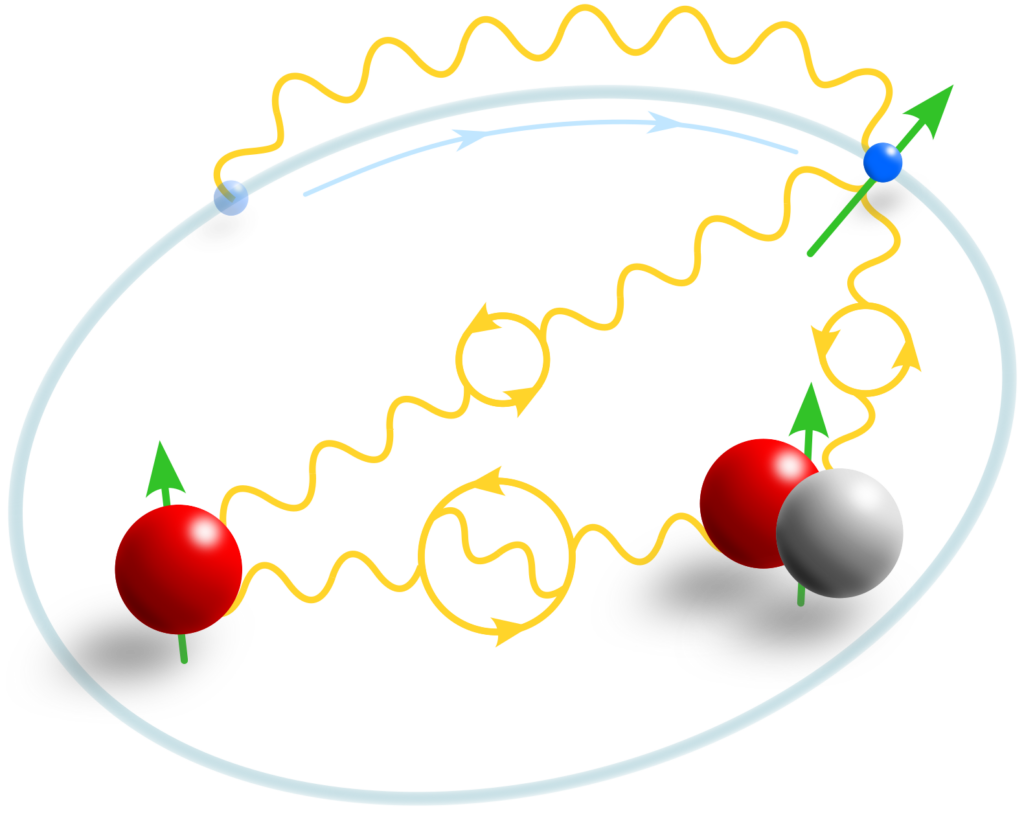
Theoretical predictions of the properties of a molecular hydrogen ion are tested by a high-precision measurement, laying a foundation for the improved determination of fundamental constants.
Understanding how the simplest constituents of matter interact with each other is the foundation of modern physics. Comparing quantities that can be both measured and calculated to high precision, enables tests of the most foundational models that describe the universe. The molecular hydrogen ion HD+, a bound system containing just a proton, a deuteron, and a single electron, provides an excellent platform for such tests. In HD+, the spins of the constituents interact with each other, giving rise to what is known as hyperfine structure. In addition, the magnetic moment of the electron, described by its so-called gyromagnetic factor (g-factor in brief), is subtly modified with respect to that of a free electron due to its binding to the proton and deuteron.
Both the hyperfine structure and the g-factor can be calculated in the framework of the quantum electrodynamics theory, the quantum field theory describing the electromagnetic force. Researchers of the Kastler Brossel laboratory (Paris) and Kassel university were able to predict the g-factor of the bound electron to a relative precision of 5 parts in 100 billion.
These predictions were put to test as an experimental group at the Max-Planck-Institut für Kernphysik (MPIK) in Heidelberg isolated and trapped a single HD+ ion and were able investigate its hyperfine structure. In particular, the g-factor of the bound electron was measured with a precision that almost matches that of the theory prediction. The experimental and theoretical values were found to be in excellent agreement.
In recent years, precision measurements with the simplest molecules, such as HD+, have become an important testbed for quantum theory and enable researchers to determine fundamental quantities such as the mass of the proton relative to the mass of the electron. The experimental methods demonstrated at MPIK will soon be used to perform laser spectroscopy of the HD+ molecule in order to probe its vibrations and rotations. The ability to work with a single, well-isolated trapped ion is expected to substantially improve the precision of those tests.
Beyond, these results open fascinating perspectives to test the equivalence of properties of matter and antimatter, thus probing one of the most fundamental principles underlying physical theories. As anti-hydrogen atoms are produced with increasing efficiencies at CERN, it may become possible to create the first antimatter molecules. Then, it would suffice to trap a single such molecule, whose properties could be measured in exactly the same way as demonstrated for HD+.
The collaborative effort involved the experimental groups at MPIK Heidelberg, and Heinrich-Heine-Universität Düsseldorf, and on the theory side, researchers from the Kastler Brossel Laboratory in Paris, the University of Kassel, and the Bulgarian Academy of Sciences in Sofia. The publication describing this work appears in Physical Review Letters.
For more information: https://journals.aps.org/prl/accepted/10.1103/vrl8-bpmz
Read also
Antimatter: coming soon to a lab near you?
News by Nancy Paul (co-author)
Glassblower at LKB – Tom Chevry
Interview published by Sciences Sorbonne Université
Shaking Atoms to Bring Black-Hole Quantum Chaos into the Lab
New publication led by Nathan GoldmanThis paper was selected as an Editors’ Suggestion in Physical Review Letters (PRL).