1. Home
  2. Laboratory
  3. Presentation
  4. News
  5. International Day of Women and Girls in Science
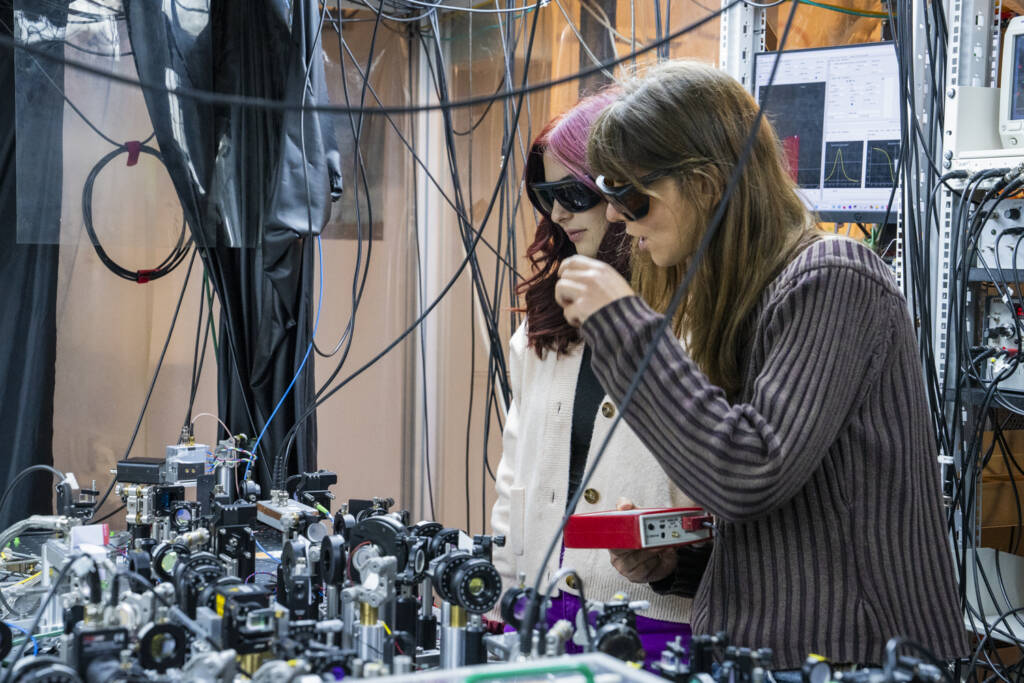
Picture: Sorbonne Université – Guillaume Blanquet

11 February 2026 was the International Day of Women and Girls in Science, an ideal opportunity to highlight some of the most striking scientific results obtained by the women in our lab.

In a series of posts, we shared on social media a selection of remarkable scientific contributions by the female permanent researchers at the LKB.

Alice Sinatra

Alice Sinatra and her team laid the theoretical foundations for an extremely precise sensor network. By splitting a Bose–Einstein condensate into several correlated atomic clouds, the researchers succeeded in jointly measuring several physical parameters with a precision exceeding the standard quantum limit.

You can read more about this recent work on our webpage [https://www.lkb.fr/en/laboratoire/presentation/actualites/quantum-metrology-a-sensor-network-to-surpass-the-standard-limit/] or you can directly read the scientific article [https://www.science.org/doi/10.1126/science.adt2442]

Valentina Parigi

Valentina Parigi and her team are working at the interface between network science and quantum optics. The team experimentally demonstrated an optical simulator for open quantum systems with complex network environments. This system provided an ideal testbed for studying quantum non-Markovianity.

[https://doi.org/10.1103/PRXQuantum.4.040310]

Nancy Paul

Nancy Paul and her team performed the first demonstration of a quantum X-ray sensor (microcalorimeter) with an atom composed of antimatter. These experimental techniques open a new window for studying fundamental theories such as quantum electrodynamics.

You can read about these advances in [https://home.cern/news/news/experiments/antiprotons-test-standard-model] and [https://ep-news.web.cern.ch/content/telmax-new-era-flexibility-cerns-antimatter-factory]

Elisabeth Giacobino

Elisabeth Giacobino is not only the president of the French Physical Society; she also has a rich research career filled with groundbreaking results. We highlight two:

Elisabeth and her team were the first to demonstrate in 1987 that an optical parametric oscillator consisting of a nonlinear crystal pumped by a laser emits twin quantum beams. Here, photons are emitted in pairs, each photon of a pair going into one of the beams. The difference in noise between the two beams is then much smaller than the standard quantum noise.

[https://doi.org/10.1103/PhysRevLett.59.2555]

Two decades later, in 2009, Elisabeth and her team performed the first observation of the superfluid propagation of a quantum light fluid created by laser excitation in a semiconductor microcavity. Superfluidity is manifested by the complete suppression of elastic scattering at defects in the structure when the fluid velocity is less than the speed of sound.

[https://doi.org/10.1038/nphys1364]

Pauline Yzombard

When Pauline Yzombard joined Alban Kellerbauer’s team at MPI-K in Heidelberg for her postdoc, the group had been working for years on laser-cooling atomic anions. The problem with anions is that the extra electron is very weakly bound, and only three species theoretically allow a bonding excited state: Osmium- and Lanthanium-. After years of experimental research to find these transitions, Pauline joined the team, and there were only 18 months of funding left before the project was completely shut down. She stumbled upon a theoretical paper by Anne Crubellier, a physicist from her former lab, proposing a method for cooling trapped negative ions using a laser:

[https://iopscience.iop.org/article/10.1088/0953-4075/23/20/020]

Within the remaining six months of funding, Anne’s technique was implemented, 30 years after her initial theoretical paper.

[https://journals.aps.org/prl/abstract/10.1103/PhysRevLett.123.103201]

Hanna Le Jeannic

One of the experimental results that Hanna Le Jeannic is most proud of dates back to her postdoctoral work at the Niels Bohr Institute in Copenhagen. There, she studied the nonlinear interaction between two photons arriving simultaneously at a two-level quantum emitter—a system that can be thought of as an ‘artificial atom’. What particularly struck her was how the emitter coherently distorted the photon wave packet, an effect directly linked to the photon-photon interaction at the heart of the system.

For Hanna the study is also special because of the simplicity and efficiency of the experimental setup: just laser pulses resonating with our atom. Despite a somewhat makeshift device using whatever they had on hand to generate the optical pulses, they were able to precisely control the excitation conditions. Another fun fact: Even before launching the experiment, the results of their preliminary simulations seemed so surprising that the team suspected numerical errors in the code. Yet, from the very first measurements, the correspondence between the experimental data and the theoretical predictions was perfect—a rather rare occurrence in experimental physics: the experiment immediately and directly confirmed the calculations!

Hanna and her co-workers then devoted considerable time to deciphering the underlying physics to understand how the emitter produced this effect on the photons. Observing this phenomenon has opened up promising avenues. It suggests that it might be possible to exploit this interaction to design controlled and deterministic quantum operations, which would be a significant advance over classical probabilistic approaches.

[https://www.nature.com/articles/s41567-022-01720-x]
Saïda Guellati-Khelifa

Saïda Guellati-Khelifa and her team achieved the most precise determination of the fine-structure constant to date using atom interferometry. To push the limits of this precision even further, they developed an innovative in situ method to directly probe the wave-vector dispersion as experienced by atoms within the vacuum chamber, using a Bose–Einstein condensate as a moving probe.

You can read more about this recent work on: [https://www.quantamagazine.org/physicists-measure-the-magic-fine-structure-constant-20201202/] or you can directly read the scientific article: [https://doi.org/10.1103/x2x9-dt38]

Read also