- Home
- Laboratory
- Presentation
- News
- Dichroism from chiral thermoelectric probes: Generalized sum rules for orbital and heat magnetizations
Dichroism from chiral thermoelectric probes: Generalized sum rules for orbital and heat magnetizations
New publication by Baptiste Bermond, Anaïs Defossez and Nathan Goldman from LKB, in collaboration with Lucila Peralta Gavensky (ULB, Brussels) – as Physical Review B editors’ suggestion

Sum rules establish fundamental connections between excitation spectra and ground-state properties, and have recently emerged as powerful tools to probe geometric and topological features of quantum matter. So far, most formulations have been restricted to electrical responses, relating frequency-integrated conductivity to quantities such as the Berry curvature and the Chern number.
In this work, the authors extend this framework to thermoelectric and thermal transport. Focusing on electric–heat and heat–heat current correlations, they show that orbital and heat magnetizations admit spectral representations in terms of generalized sum rules. By analyzing zero-temperature transport coefficients and exploiting Kramers–Kronig relations, the authors express these magnetizations as integrals over thermoelectric response functions, placing them on equal footing with topological invariants.
The authors further demonstrate that chiral thermoelectric drives provide direct experimental access to these quantities: frequency-integrated dichroic excitation rates probe the underlying Kubo correlators and thereby encode orbital and heat magnetization densities. This approach also enables a systematic decomposition of magnetization into distinct physical contributions, and reveals an additional geometric quantity—a heat quantum metric—accessible via non-chiral probes.
These results establish a unified framework in which thermoelectric dichroism provides direct access to ground-state magnetization and geometric properties from dynamical measurements in quantum-engineered systems.
For more information:
Read also
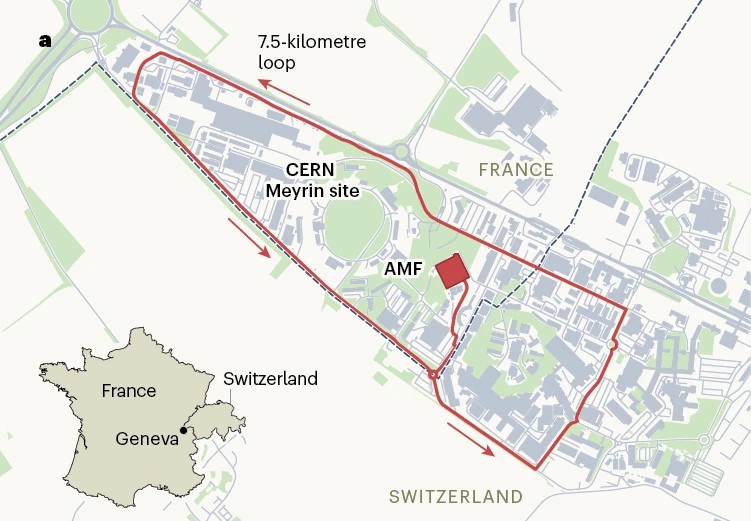
Antimatter: coming soon to a lab near you?
News by Nancy Paul (co-author)
Glassblower at LKB – Tom Chevry
Interview published by Sciences Sorbonne Université
Shaking Atoms to Bring Black-Hole Quantum Chaos into the Lab
New publication led by Nathan GoldmanThis paper was selected as an Editors’ Suggestion in Physical Review Letters (PRL).