- Home
- Laboratory
- Presentation
- News
- Continuous variable quantum reservoir computing: quantum light with memory
Continuous variable quantum reservoir computing: quantum light with memory
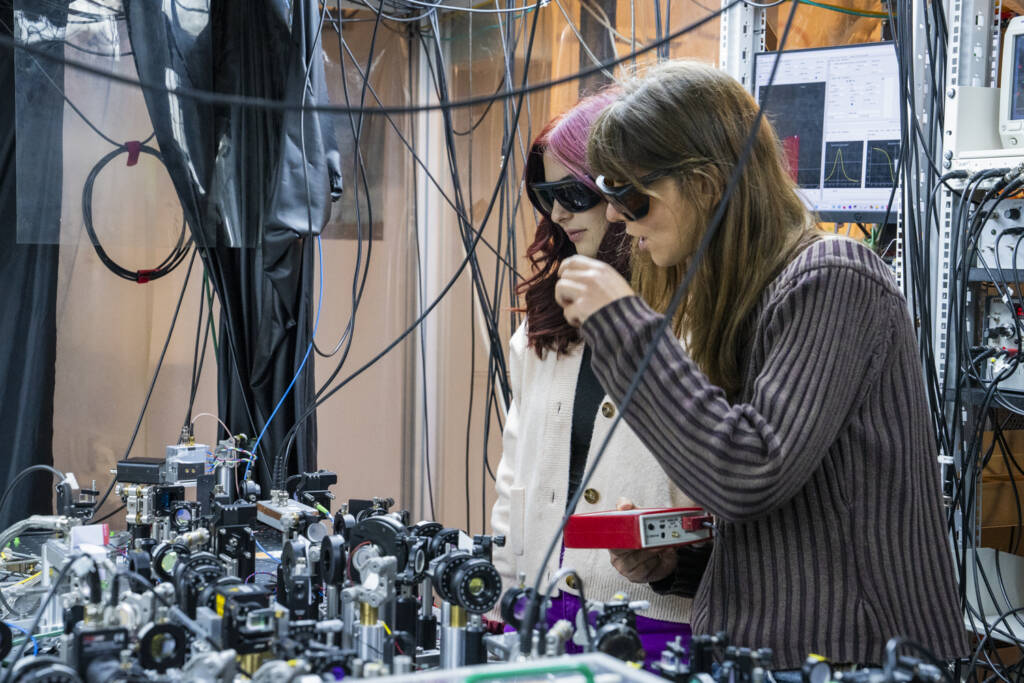
By combining the expertise of LKB (Laboratoire Kastler Brossel) in Paris and IFISC (Instituto de Física Interdisciplinar y Sistemas Complejos) in Palma de Mallorca, this collaboration provides new experimental and numerical insights into quantum machine learning.
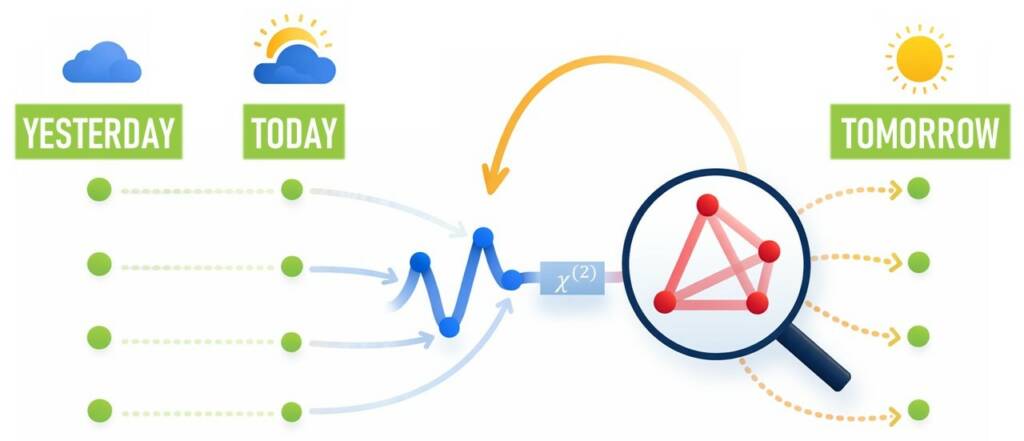
From financial markets to climate data and brain activity, many real-world problems depend on recognizing patterns that evolve over time.
In this work, published in Nature Photonics, we demonstrate an experimental quantum photonic reservoir computer equipped with memory.
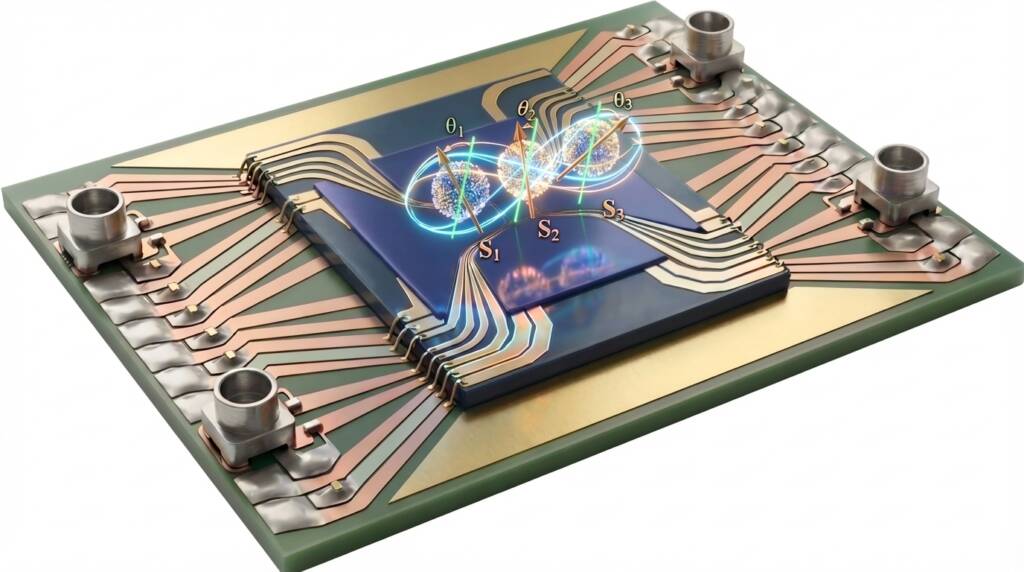
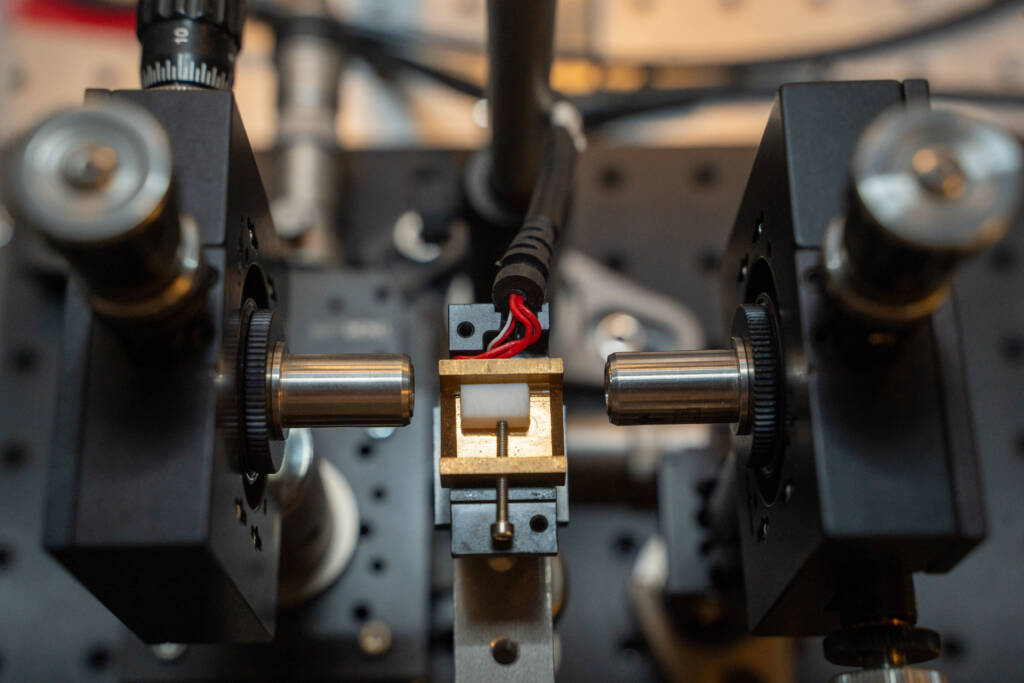
Reservoir computing is a powerful framework for processing time-dependent data with minimal training. Instead of training a large network, one harnesses the natural dynamics of a complex physical network, the reservoir, and trains only the output layer. In our case, the reservoir is a quantum system of light, where entanglement is distributed across multiple frequency bands. The experimental platform was developed within the ERC Grant COQCOoN (Continuous Variable Quantum Complex Networks), awarded to V. Parigi, and is supported by the PEPR OQuLus ( Light-based quantum computers in discrete and continuous variables). The theoretical framework is developed at IFISC, in the groups of R. Zambrini.
We operate in the continuous-variable framework, where information is carried by optical field quadratures and read out using room-temperature coherent detectors. The encoding can be achieved by modulating phase and amplitude of the different spectral components of the classical pump laser in the nonlinear optical process that generates quantum correlations among frequency bands. By introducing real-time feedback of the measured signals, we equip the reservoir with fading memory, ensuring that past inputs influence future states, a necessary ingredient for learning temporal patterns.
Importantly, leveraging the entangled multimode structure of the light enhances both the memory capacity and the expressive power of the system, referred to as “expressivity,” which quantifies the amount of information that can be processed simultaneously by the system. This improvement enables our quantum reservoir to learn more complex temporal patterns than classical architectures. In particular, we show that the expressivity scales quadratically with the number of measured frequency components, in agreement with our earlier theoretical work, in which we predicted such quadratic scaling for quantum states with Gaussian probability distributions of quadratures.
Even before reaching the regime of non-Gaussian quadrature distributions, known to unlock the computational power in the quantum regime, this work opens a concrete path toward practical quantum-enhanced learning.
For more information: