- Home
- Laboratory
- Presentation
- News
- A Fermionic Waltz – Scientists Image Unexpected Patterns in Atom Pairs
A Fermionic Waltz – Scientists Image Unexpected Patterns in Atom Pairs
New publication from Tarik Yefsah’s group
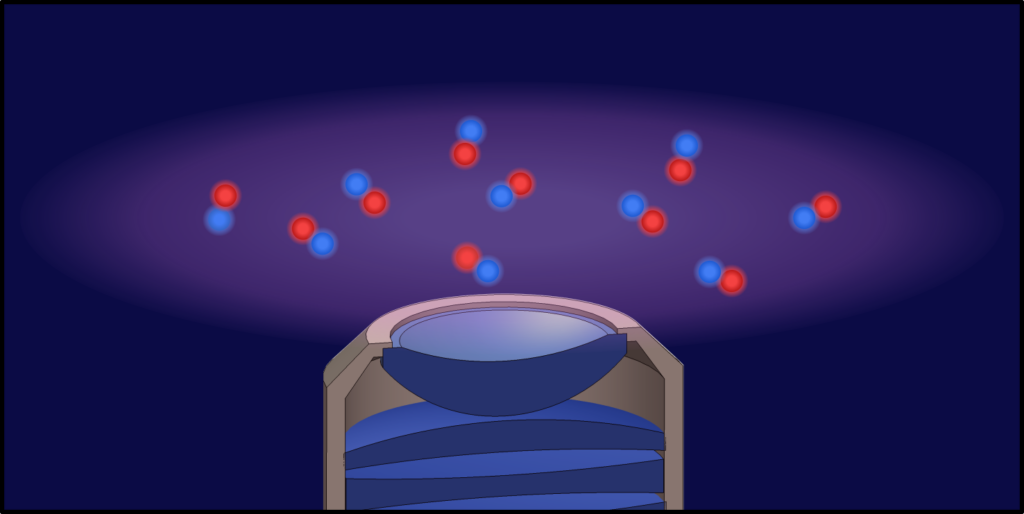
Superconductors, materials in which electrical current flows without resistance, hold enormous promise for future technologies, from ultra-efficient energy transport that can reduce global power consumption, to non-heating electronics and laptops. Our theoretical understanding of superconductivity dates back more than half a century to the Bardeen-Cooper-Schrieffer (BCS) theory, which explains how electrons in a conductor can pair up through attractive interactions, allowing current to flow freely.
Scientists expect, however, that this pairing is not the whole story: instead, the fermions pair up in the middle of a collective of other particles that can affect their motion, much like how a ballroom of dancing couples have to try not to bump into one another. Many details about this microscopic organization of paired fermions have remained elusive, as it requires directly probing their spatial organization.
Historically, electrons have been the central “dancers” in this story, yet what truly matters for pairing is more general. First, the particles involved need to be fermions, which are (with bosons) one of the two fundamental classes of particles in the universe, and which electrons belong to. Second, the particles must experience attractive interactions. By isolating these essential ingredients in the laboratory, physicists can recreate and study superconductivity-like physics in a highly controlled way.
In a recent work published in Physical Review Letters [1], a team of experimentalists at École Normale Supérieure in Paris led by CNRS Researcher Tarik Yefsah, together with theory collaborators Shiwei Zhang of the Flatiron Institute in New York and Yuan-Yao He from the Institute of Modern Physics at Northwest University in Xi’an directly observed fermions forming into pairs. The researchers used a lithium-based quantum simulator, an experiment in which a gas of fermionic Lithium atoms is cooled to temperatures near absolute zero, to study the fermionic ballroom at the most fundamental level.
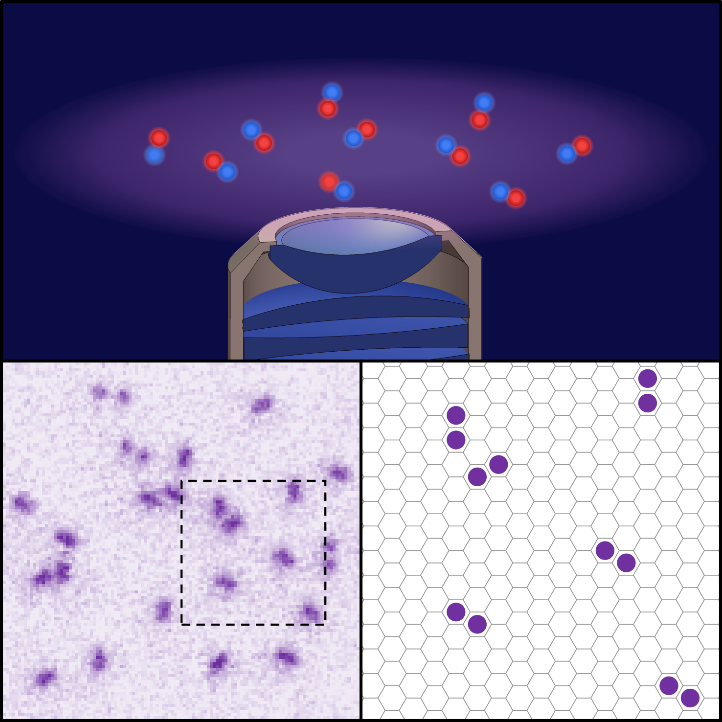
Building on their previous work with non-interacting fermions [2], the team used a quantum gas microscope that can see individual atoms [3]. By adding and controlling interactions between the particles, they observed how the particles’ positions progressively paired up as their mutual attraction increased. Beyond simply forming pairs, the atoms also displayed surprising long-range patterns, where the positions of distant particles became dependent on each other. These unexpected correlations, not predicted by the original BCS theory, are confirmed by exact numerical calculations. This work provides the first quantitative real-space view of how pairing emerges, revealing new organizing rules of interacting fermions which the textbook theory of pairing fails to capture, even in regimes long believed to be well understood.
Going further, the researchers studied the connection between two-particle and three-particle correlations. In the ballroom analogy, this reveals how one dancing couple pays attention to the closest dancer of another pair. Moreover, using a controlled loss of atoms when they are imaged close to each other, they precisely measured how strongly the particles pair up at short distances as interactions are varied.
Together, these findings provide a new, intuitive picture of how fermions arrange themselves at the microscopic level. By exposing previously hidden principles that shape quantum matter, the experiment opens a new path toward understanding complex materials, such as those that exhibit superconductivity.
This work has been selected as an Editor’s Suggestion in Physical Review Letters and is featured in Viewpoint in Physics.
References
- C. Daix et al., Observing Spatial Charge and Spin Correlations in a Strongly-Interacting Fermi Gas, Physical Review Letters, 136, 153402 (2026)
- T. de Jongh et al., Quantum gas microscopy of fermions in the continuum, Physical Review Letters, 134 (18), 183403 (2025)
- J. Verstraten et al., In Situ Imaging of a Single-Atom Wave Packet in Continuous Space, Physical Review Letters, 134 (8), 083403 (2025)
For more information:
– The article: https://journals.aps.org/prl/abstract/10.1103/2t2k-3ftx
– The viewpoint in Physics: https://physics.aps.org/articles/v19/54
– The Simons Foundation press release: https://www.simonsfoundation.org/2026/04/15/scientists-capture-superconductivitys-dancing-pairs-for-first-time-filling-gap-in-decades-old-theory/
Read also
A new breakthrough improves nuclear material monitoring using ultra-precise quantum sensors
New publication: Paul Indelicato is a co-author
Antimatter: coming soon to a lab near you?
News by Nancy Paul (co-author)
Glassblower at LKB – Tom Chevry
Interview published by Sciences Sorbonne Université