
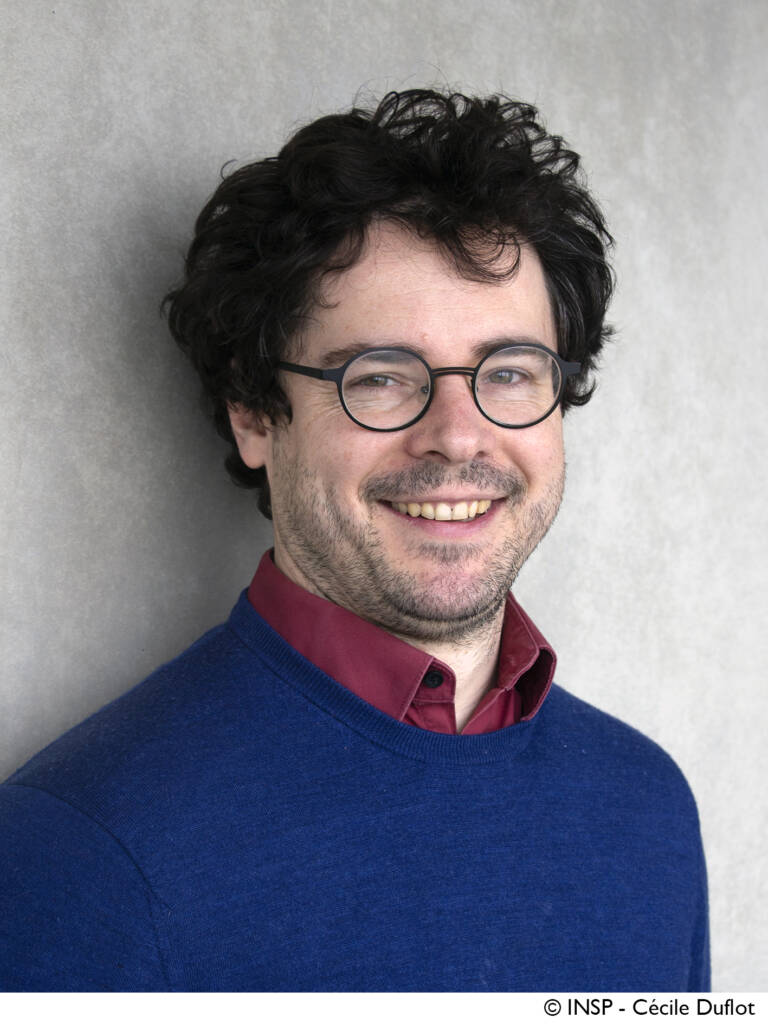
Martino Trassinelli
Classical and quantum probability, two faces of the same medal (and the medal is quantum)!
Date & heure
05/12/2024 – 14h
Lieu
4 place Jussieu 75005
13-23, salle 210
Accueil
Rendez-vous à 13h45 si vous souhaitez partager une tasse de café ou de thé avec nous ! L’atelier commence à 14 heures.
In 1951, Feynman wrote, “The concept of probability is not altered in quantum mechanics. … What is changed, and changed radically, is the method of calculating probabilities”. This is not necessarily true. I demonstrate here that classical and quantum probabilities can be described in a unique framework from very simple assumptions. This universal definition has, however, a price: the distributive property of the probability function argument is no longer valid. In a first step, I demonstrate the non-validity of distributivity when sharp measurements, represented by projectors, are considered. Unsharp measurements are also considered (using the POVM formalism) to investigate, in particular, intermediate cases between “classical” and “quantum” probabilities. In a second step, the dynamical evolution will be taken into account, but taking out the special role of time as an evolution parameter. Using the Page-Wootters method, time is now the result of an additional measurement of a “quantum clock.” One-time conditional probabilities are unambiguously derived, including for puzzling cases like the Wigner’s-friend scenario. Paradoxical situations are excluded, and the roles of Wigner and the friend are completely interchangeable with one described in a superposition state with respect to the other.