
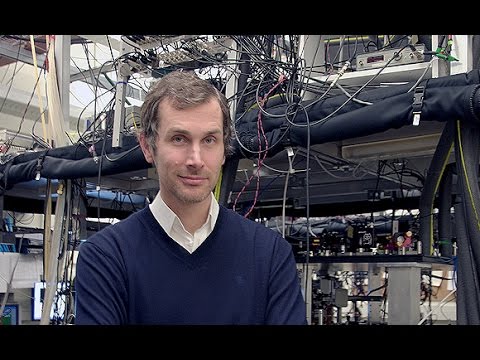
Joseph H. Thywissen
Spin transport in 3D and 2D strongly interacting Fermi gases
Date & heure
15/03/2017
Lieu
ENS, salle Conf IV
Accueil
Transport in strongly interacting systems is a topic of broad interest to physicists, studied in materials, fluids, cold atoms, and even in theories using holographic duality. Here we study spin transport in the demagnetization dynamics of a strongly interacting ultracold Fermi gas. Atoms are initialized in a superposition of two internal states, creating a transverse magnetization that decays in the presence of a magnetic field gradient. We observe the ensemble-averaged magnetization with a spin-echo sequence, and measure two-body correlations (the contact) with time-resolved rf spectroscopy.In the strongly interacting regime, the dynamics are found to be diffusive. The spin diffusivity reaches a lower bound, roughly 2 hbar/m (where m is the bare mass of the potassium 40 atoms used here), when interactions are tuned to unitarity. We also find a reactive component to dynamics, due to the spin-rotation effect, where the spin current precesses around the local magnetization. Finally, we compare dynamics in three- and two-dimensional gases. Our work supports the conjecture of an upper bound on the rate of relaxation to local equilibrium.

Daniele Sanvitto
Istituto di Nanotecnologia –CNR Nanotec, Lecce & Roma, Italy
Collective phenomena in non-equilibirum quantum fluids

DigiQ Paris Summer School 2026
29 juin – 2 juillet

Giovanna Morigi
Theoretical Physics, Saarland University, 66123 Saarbruecken, Germany
Searching a quantum database with noise