ERC grant COQCOoN of Valentina Parigi –( 2019-2025)
At different scales,from molecular systems to technological infrastructures, physical systems group in structures which are neither simply regular or random, but can be represented by networks with complex shape. Proteins in metabolic structures and the World Wide Web, for example, share the same kind of statistical distribution of connections of their constituents. In addition, the individual elements of natural samples, like atoms or electrons, are quantum objects. Hence replicating complex networks in a scalable quantum platform is a formidable opportunity to learn more about the intrinsic quantumness of real world and for the efficient exploitation of quantum-complex structures in future technologies. Future trusted large-scale communications and efficient big data handling, in fact, will depend on at least one of the two aspects -quantum or complex- of scalable systems, or on an appropriate combination of the two.
We investigate theory and experimental implementation of quantum complex networks in the framework of continuous variables encoding of quantum resources.
Multimode quantum resources based on parametric process, femtosecond laser along with mode-selective and multimode homodyne measurements, allows for the implementation of networks with reconfigurableall-to-all coupling and topology, with sufficient size and diversity to be relevant in the context of complex networks. We can deterministically generate complex graphs of entanglement correlations between the involved fields and establish mappingbetween the resource and complex networks of physical interactions .
Contact us (valentina.parigi@lkb.upmc.fr) for more information
Available Postdoc positions !
Experimental setups
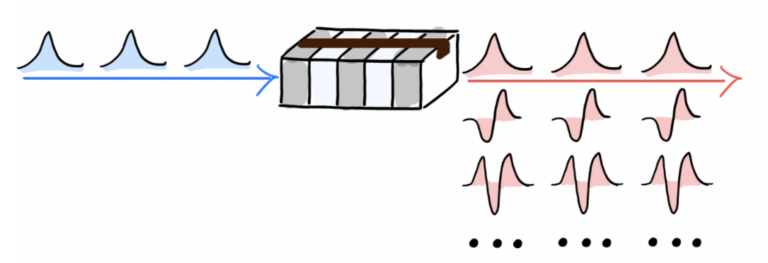
Spectrally shaped and pulse-by-pulse multiplexed multimode squeezed states of light
Tiphaine Kouadou, Francesca Sansavini, Matthieu Ansquer, Johan Henaff, Nicolas Treps, Valentina Parigi APL Photonics 8, 086113 (2023)
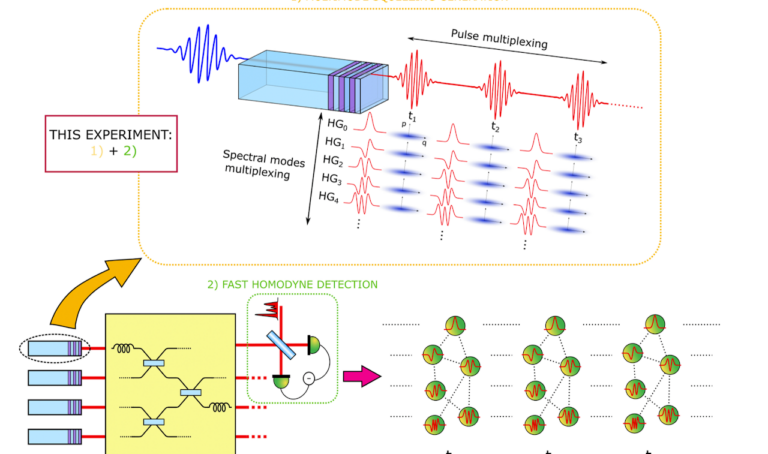
We demonstrate the simultaneous generation of 21 squeezed spectral modes at 156 MHz. We exploit the full repetition rate and the ultrafast shaping of a femtosecond light source to combine, for the first time, frequency- and time- multiplexing in multimode squeezing.
Multimode Squeezed State for Reconfigurable Quantum Networks at Telecommunication Wavelengths
Victor Roman-Rodriguez, David Fainsin, Guilherme L. Zanin, Nicolas Treps, Eleni Diamanti, Valentina Parigi arXiv:2306.07267(2023)
Experimental source of multimode squeezed states of light at telecommunication wavelengths. Generation at such wavelengths is especially important as it can enable quantum information processing, communication, and sensing beyond the laboratory scale. We measured significant squeezing in more than 21 frequency modes, with a maximum squeezing value exceeding 2.5 dB. We demonstrate multiparty entanglement by measuring the state’s covariance matrix. Finally, we show the source reconfigurability by preparing few-node cluster states and measure their nullifier squeezing level.
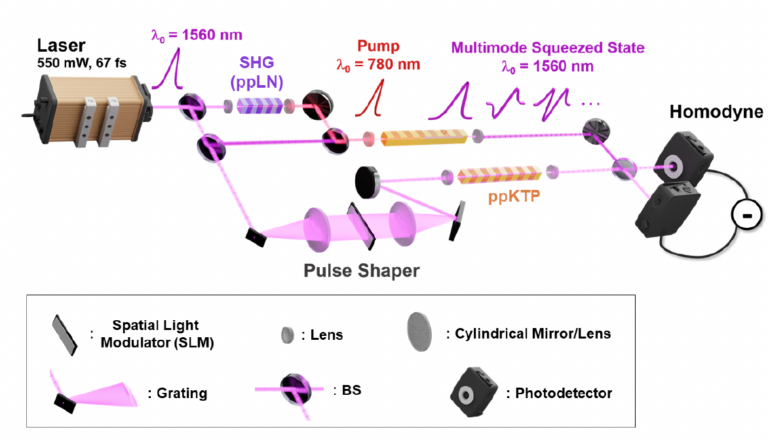
New results : -Tiphaine Kouadou, Elie Gozlan, Loïc Garcia, David Polizzi, David Fainsin, Iris Paparelle, RL Celis, Bastien Oriot, Anthony Abi Aad, Peter Namdar, Ganaël Roland, Nicolas Treps, Bérengère Argence, Valentina Parigi Homodyne detection for pulse-by-pulse squeezing measurements, arXiv preprint arXiv:2511.04578 (2025)
Routing in CV quantum networks
Internet is a physical complex network characterized by a scale-free structure which has been investigated to be resilient to external attacks [Goh02] Quantum communication will be delivered in networks, and part of quantum information protocols too. We investigate which complex shapes of networks will be the most effective in quantum technologies. In particular we are interested in CV cluster states, a particular kind of multipartite entangled states, shaped as complex networks. In the Continuos Variable regime it is easy to produce large entangled network. You may ask, given finite realistic resources, what are the best networks we can build in term of errors and computational noise for quantum information protocols.
Recent results :
D Fainsin, A Debray, I Karuseichyk, M Walschaers, V Parigi Entanglement routing via passive optics in CV-networks EPJ Quantum Technol. 12, 143 (2025)
Federico Centrone, Frederic Grosshans, and Valentina Parigi Cost and routing of continuous-variable quantum networks, Phys. Rev. A 108, 042615 (2023) , or arXiv 2108.08176
F. Sansavini and V. Parigi, Continuous Variables Graph States Shaped as Complex Networks: Optimization and Manipulation, Entropy 22, 26 (2020)

Quantum reservoir computing in CV systems
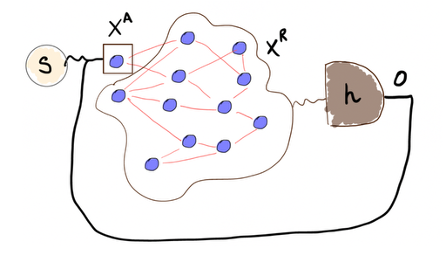
Quantum reservoir computing aims at harnessing the rich dynamics of quantum systems for machine-learning purposes. It can be used for online time series processing while having a remarkably low training cost. Here, we establish the potential of continuous-variable Gaussian states of linear dynamical systems for quantum reservoir computing.
New experimental and theoretical results on quantum reservoir !
Iris Paparelle, Johan Henaff, Jorge Garcia-Beni, Emilie Gillet, Daniel Montesinos, Gian Luca Giorgi, Miguel C. Soriano, Roberta Zambrini, Valentina Parigi Experimental memory control in continuous variable optical quantum reservoir computing arXiv:2506.07279 (2025)
Jorge García-Beni, Iris Paparelle, Valentina Parigi, Gian Luca Giorgi, Miguel C Soriano, Roberta Zambrini Quantum machine learning via continuous-variable cluster states and teleportation EPJ Quantum Technology 12,63 (2025)
J Henaff, M Ansquer, MC Soriano, R Zambrini, N Treps, V Parigi Optical phase encoding in pulsed approach to reservoir computing Optics Letters Vol. 49, Issue 8, pp. 2097-2100 (2024) arXiv:2401.14073 (2023)
J. Nokkala, R. Martínez-Peña, G. L. Giorgi, V. Parigi, M. C Soriano, R. Zambrini, Gaussian states of continuous-variable quantum systems provide universal and versatile reservoir computing, Communications Physics volume 4, Article number: 53 (2021)
Simulation of structured quantum environment
P. Renault, J. Nokkala, G. Roeland , N. Y. Joly R. Zambrini, S. Maniscalco, J. Piilo N. Treps, V. Parigi, Experimental optical simulator of reconfigurable and complex quantum environment, PRX Quantum 4, 040310 (2023)
No quantum system can be considered totally isolated from its environment. In most cases the interaction between the system of interest and the external degrees of freedom deeply changes its dynamics, as described by open quantum system theory. Nevertheless engineered environment can be turned into beneficial effects for some quantum information tasks. Here we demonstrate an optical simulator of a quantum system coupled to an arbitrary and reconfigurable environment built as a complex network of quantum interacting systems. We experimentally retrieve typical features of open quantum system dynamics like the spectral density and quantum non-Markovianity, by exploiting squeezing and entanglement correlation of a continuous-variable optical platform. This opens the way to the experimental tests of open quantum systems in reconfigurable environments that are relevant in, among others, quantum information, quantum hermodynamics, quantum transport, and quantum synchronization
Non-Gaussian CV quantum states
Peter Namdar, Carlos E Lopetegui, Silia Babel, Benjamin Brecht, Christine Silberhorn, Valentina Parigi, Spectro-temporally tailored Non Gaussian Quantum Operations in Thin-Film Waveguides arXiv:2508.04578 (2025)
M. Walschaers, N. Treps, B. Sundar, L. D. Carr, V. Parigi Emergent complex quantum networks in continuous-variables non-Gaussian states, Quantum Sci. Technol. 8 035009 (2023) or arXiv 2012.15608
G. Roeland, S. Kaali, V. Roman Rodriguez, N. Treps, V. Parigi, Mode-selective single-photon addition to a multimode quantum field, New Journal of Physics 24 (4), 043031 (2022)
V. Cimini, M. Barbieri, N. Treps, M. Walschaers, and V. Parigi, Neural Networks for Detecting Multimode Wigner Negativity, Phys. Rev. Lett. 125, 160504 (2020) or arXiv 2003.03343