Research themes
Microfabricated mechanical resonators. We design and fabricate silicon nitride membranes with low mechanical dissipation. Optical interferometry maps their vibration modes and guides phononic and edge-mode engineering (Ivanov et al., 2020 ).
Hybrid superconducting–mechanical circuits. We couple membrane motion to superconducting microwave resonators and qubits, developing sensitive readout and rf-to-microwave transduction (Patange et al., 2026 ).
Unconventional superconducting qubits. Our MHz-frequency heavy-fluxonium qubits combine strong nonlinearity with sensitive ac-charge detection. We also develop hyperinductances made from stacked Josephson junctions for new circuit architectures (Nájera-Santos et al., 2024 ; Manset et al., 2026 ).
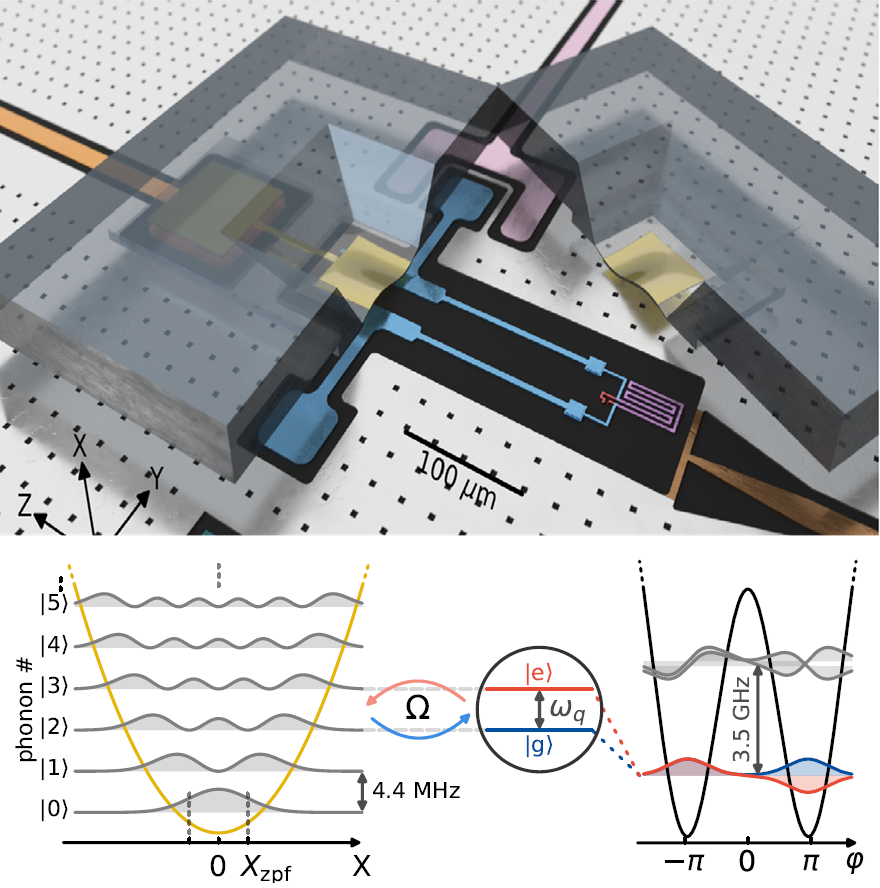
Resonant quantum electromechanics. Resonant coupling between a membrane and a heavy-fluxonium qubit enables coherent excitation exchange and probes the quantum signatures of mechanical motion. We aim to prepare nonclassical mechanical states and test collapse models, including gravity-related decoherence (Gerashchenko et al., 2026 ).
Experimental facilities
Our work combines access to cleanrooms at ENS and Sorbonne University, a dilution refrigerator for millikelvin experiments, digital holographic microscopy (DHM), and sensitive optical interferometry for device and vibration characterization.
Collaborations
Our superconducting-circuit and qubit research is developed with Emmanuel Flurin (CEA, Quantronics) and Zaki Leghtas and Antoine Tilloy, through collaborations with LPENS, Inria and Mines Paris – PSL.
Funding
Our research is supported by ANR, DIM Quantip, Région Île-de-France, Sorbonne Université and IUF.